
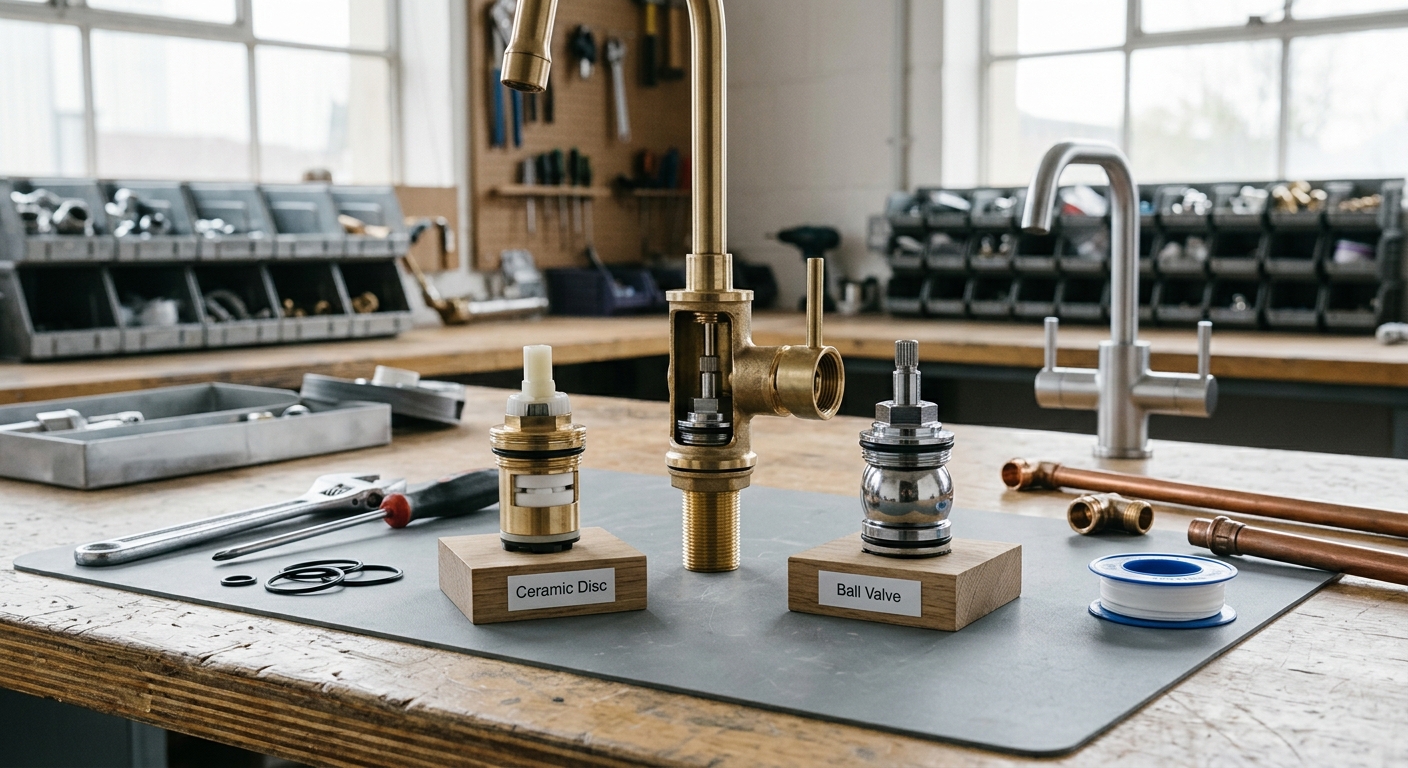
Ceramic disc cartridges give you a quarter-turn handle motion and a rated life around 500,000 cycles before the discs wear enough to drip. Ball valve cartridges use a multi-turn or lever-sweep motion over rubber seals and springs, which feel different under the hand and wear on a different timeline, especially in hard water. The choice isn’t just mechanical, it decides whether your faucet gets a single lever, a cross handle, or two separate handles, and that decision shows up on the spec sheet before it shows up at the job site.
The Design Problem: Handle Feel and Form
A faucet handle is the one moving part a client touches every day, so the feel of that motion is part of the design brief whether anyone states it or not. Quarter-turn hardware reads as modern and minimal because the handle travels 90 degrees and stops with a hard, mechanical click. Multi-turn or sweep-style ball valve handles read as more traditional, with a longer, smoother arc of motion that some clients associate with older or more substantial fixtures, even though the internal mechanism is often less durable than the discs.
This matters at the spec stage because handle rotation affects clearance. A quarter-turn lever needs less swing radius than a cross handle on a multi-turn stem, which can matter in a tight vanity run or when two faucets sit close together on a trough sink.
Ceramic Disc Mechanics and Wear Life
A ceramic disc cartridge uses two flat discs, one fixed and one that rotates or shifts against it, each with matched ports. Turning the handle slides the ports into alignment to open flow and meter temperature. There’s no rubber seal doing the primary sealing work; the discs ride against each other with extremely tight tolerances, which is why they’re rated for roughly 500,000 cycles or more in residential service before wear produces a drip.
The tradeoff is grit sensitivity. Sediment, scale flakes from old galvanized piping, or debris kicked loose during a repipe can scratch the disc faces and shorten that life considerably. Ceramic disc cartridges perform best downstream of clean, filtered supply water and don’t love being the first fixture turned on after a plumbing repair that stirred up the lines.
Ball Valve Mechanics and Wear Life
A ball valve single-handle design uses rubber seals and springs pressed against a slotted metal or plastic ball. Rotating and tilting the ball lines up its internal channel with the hot and cold inlets, blending temperature and flow in one motion. It’s a simple, repairable system, since the seals and springs are usually sold as a kit and can be replaced without swapping the whole cartridge.
The wear point is the rubber. Those seals compress against the ball every cycle, and in hard water the mineral scale that builds up on the ball surface acts like sandpaper against the seals, accelerating wear well before the mechanical parts themselves fail. In soft water conditions a ball valve can last a long time; in hard water it’s often the first thing to start dripping, and the fix is a seal kit rather than a cartridge swap.
How Cartridge Type Shapes Handle Design
Cartridge choice drives the handle layout options available, not the other way around. Here’s how the common configurations break down:
- Single-handle ceramic disc: one lever controls both volume and temperature through a rotating disc stack. Compact footprint, quarter-turn feel, common on minimalist widespread and single-hole faucets.
- Single-handle ball valve: one lever tilts and rotates to blend hot and cold. Smoother, longer handle travel, often chosen for a more traditional sweep motion.
- Double-handle ceramic disc: two separate quarter-turn cartridges, one per hot and cold line, each independently rated for the same cycle life. Common on bridge faucets and widespread sets where separate handles are part of the look.
- Double-handle compression or washer-style: older technology, not disc or ball, included here only because it still shows up in budget fixtures and should be flagged as a different wear profile entirely.
If a design calls for two handles, you’re almost always looking at ceramic disc internals even though the external hardware mimics an older look. If the design calls for one lever with a long, confident arc, that’s usually ball valve territory. Matte black and other dark finishes tend to pair with minimal single-lever designs where the quarter-turn disc mechanism keeps the silhouette clean. For a basin application, something like dark finish faucets often uses a ceramic disc cartridge under a single lever specifically to keep the handle profile low and the motion tight.
Matching Cartridge to Water Conditions
Water hardness should be on the intake questionnaire before cartridge type is finalized, not treated as an afterthought. If the project is on municipal water with no softener and hardness above roughly 7 grains per gallon, ball valve seals will see accelerated wear and the maintenance interval shortens. Ceramic disc cartridges tolerate hardness better since there’s no rubber seal degrading against scale, but they’re more sensitive to particulate, so a project with older galvanized supply lines or a well system without sediment filtration is a better fit for ball valve hardware that can be serviced in place.
A simple framework:
| Water condition | Better cartridge fit | Why |
|---|---|---|
| Hard water, no softener | Ceramic disc | No rubber seal to scale up and degrade |
| Soft water, municipal supply | Either | Both perform well; choose on handle feel |
| Well water with sediment | Ball valve | Rubber seals tolerate grit better than disc faces; add a sediment filter regardless |
| Recent repipe or renovation | Flush lines before installing disc cartridges | Debris in new lines can scratch disc faces on first use |
Final Fixture Spec Sheet Example
Here’s how this translates into an actual spec line for a powder room basin faucet, the kind of sheet you’d hand to a contractor or submit for approval:
- Fixture type: single-hole, single-handle lavatory faucet
- Finish: matte black, PVD or powder-coat process specified separately
- Cartridge type: ceramic disc, quarter-turn
- Cycle rating: manufacturer-rated minimum 500,000 cycles
- Supply connection: 1/2 inch NPT compression fittings
- Flow rate: 1.5 gpm aerator, confirm against local code if project is in California (1.2 gpm cap for bathroom faucets)
- Water condition note: confirm hardness test on file; if above 7 gpg, recommend point-of-use filtration ahead of fixture
- Maintenance access: cartridge replaceable without removing faucet body; confirm manufacturer service kit availability
That last line matters more than it looks. A cartridge rated for 500,000 cycles still eventually needs replacement, and a faucet body that has to be pulled off the deck to service the cartridge turns a 20-minute repair into a half-day job.
Before finalizing a fixture, pull the water hardness report for the project address, confirm which cartridge type the manufacturer actually ships in the model you’re specifying (don’t assume from the handle style alone), and ask whether service kits or replacement cartridges are sold separately. If the answer is no on parts availability, that’s a reason to look at a different fixture line regardless of how the handle feels in the showroom.