
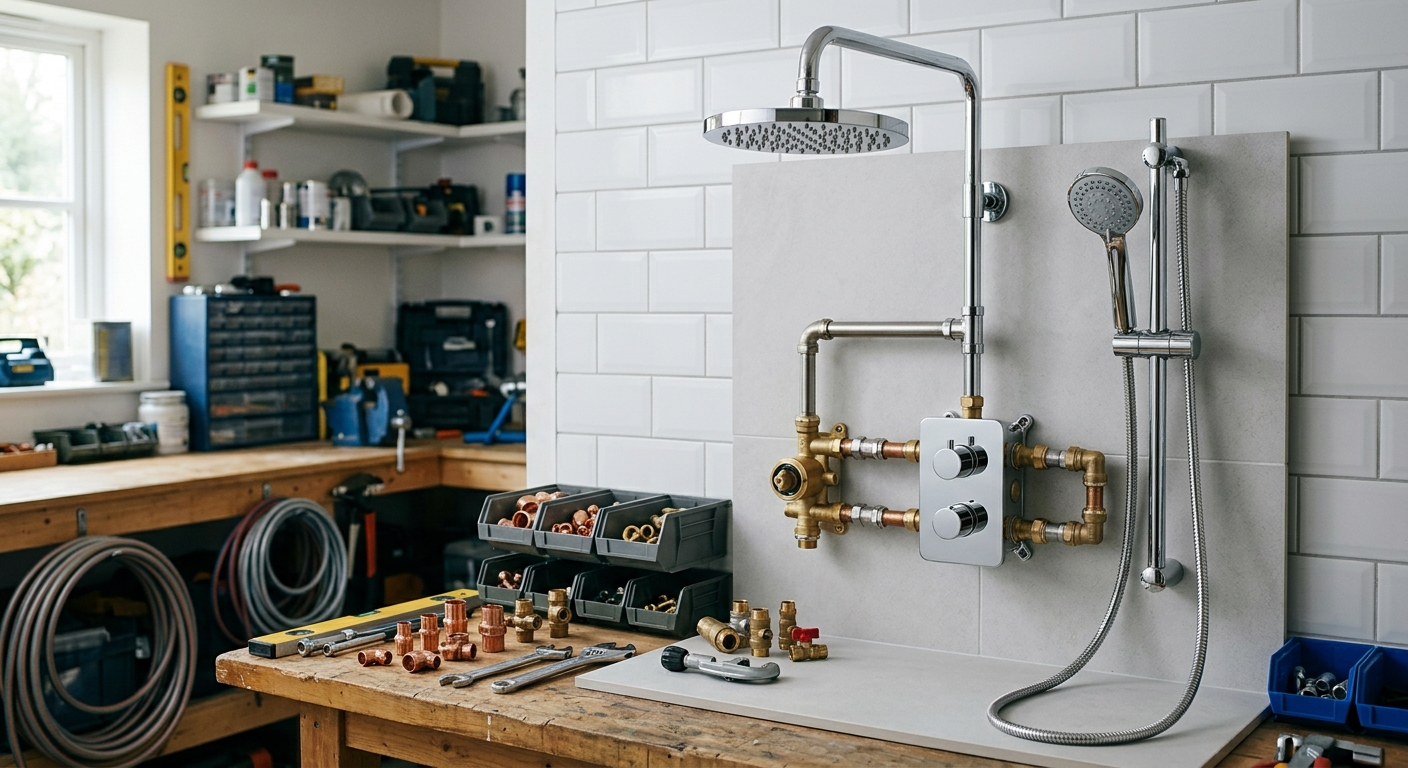
For a bathroom that gets used by a five-year-old, a teenager, and two adults on overlapping schedules, the right answer is a thermostatic valve sized for at least two outlets, with a low-flow head in the 1.5 to 1.75 GPM range and the high-limit stop set near 120°F. Everything else in this post explains why that’s the default spec, not the upgrade option, for a shared family shower.
Define the Bathroom’s Daily Use Case Before You Spec Anything
A family bathroom does three things a single-user shower doesn’t. It runs a kids’ bath or shower at a lower, more forgiving temperature while an adult is getting ready ten feet away at the sink. It gets used back-to-back in the morning, sometimes with a second outlet (a handheld for rinsing a toddler) running while the main head is on. And it has more than one person adjusting or bumping the controls over its lifespan, which means the valve has to fail safe, not just perform well on day one.
Write this down before you look at a single spec sheet: how many outlets will run, ever run simultaneously, and who is the most vulnerable user (usually the youngest or oldest person in the house). That answer drives the valve architecture, not the finish.
Thermostatic vs Pressure-Balancing Valve: Pick Based on Outlets, Not Preference
Pressure-balancing valves (built to ASME A112.18.1) hold a fixed ratio of hot to cold and react to pressure drops, like a toilet flushing elsewhere in the house. They’re a legitimate code-compliant choice for a single-outlet shower and they cost less. What they don’t do well is hold a set temperature when a second outlet opens, because the valve is reacting to pressure, not actual water temperature.
Thermostatic valves (commonly certified to ASSE 1016 or ASME A112.18.1, depending on configuration) sense actual outlet temperature and adjust accordingly. For a bathroom running a rain head and a handheld, or a body spray and a main head, this is the valve that keeps the temperature flat when someone turns on the sink or a second outlet opens. For multi-outlet family bathrooms, that’s the difference between a valve that’s merely code-legal and one that actually does the job the household needs.
- Single outlet, single user habits: pressure-balancing valve, ASME A112.18.1, adequate and economical.
- Two or more outlets, or a wide age range of users: thermostatic valve, ASSE 1016, worth the added cost.
- Whole-house pressure fluctuation history: thermostatic valve regardless of outlet count.
Sizing Flow Rate Across Multiple Outlets
Federal law caps shower flow at 2.5 GPM per head; California and a handful of other states cap it at 1.8 GPM. But the number that actually matters for a family system is the combined flow across every outlet that can run at once, not the rating printed on one shower head.
If you’re speccing a main head, a handheld, and two body sprays that can all be open simultaneously, and each is rated near the federal max, you’re asking the water heater and the supply line to deliver close to 8 GPM before anyone touches the temperature. That’s an unrealistic load for most residential systems and it will show up as poor pressure or temperature drift at the worst possible moment, mid-bath with a kid in the tub.
The practical fix is to spec low-flow outlets, in the 1.5 to 1.75 GPM range, especially for any body sprays or secondary outlets that run alongside the main head. This keeps combined draw manageable, keeps the thermostatic valve working within its designed flow window, and still meets or beats federal minimums. A 1.75 GPM main head plus two 1.5 GPM body sprays lands you around 4.75 GPM total, a load most standard water heaters and 1/2 inch supply lines handle without complaint.
| Outlet | Typical Flow (GPM) | Notes |
|---|---|---|
| Standard shower head | up to 2.5 (1.8 in CA) | Federal/state max, not a target |
| Low-flow shower head | 1.5–1.75 | Good default for multi-outlet systems |
| Handheld unit | 1.5–2.0 | Runs alongside main head in family use |
| Body spray (each) | 1.0–1.5 | Add up total before finalizing valve size |
Diverter Types for Shared Shower Systems
The diverter decides whether your flow budget stays realistic or gets blown out. A two-way diverter that sends water to either the main head or the handheld, never both, keeps total draw predictable and is the simplest, most reliable choice for a bathroom with young kids where an adult often needs to rinse a child with the handheld while the main head is off.
A three- or four-way diverter that can run multiple outlets together needs to be matched to a valve and trim rated for that combined flow, and it needs the outlet flow rates kept low as described above. Skip the diverter type that lets every outlet run at full standard flow simultaneously unless you’ve confirmed the home’s water heater and supply size can support it. This is also where it’s worth looking at complete shower valve and head sets designed with matched diverter and outlet flow rates, since piecing together a valve, diverter, and heads from different lines is where flow mismatches usually creep in.
Scald Safety and Code Requirements
This is not optional in a household with kids or older adults. Set the high-limit stop on the thermostatic (or pressure-balancing) valve near 120°F. Most valves ship with a factory default around 120°F but the stop is field-adjustable, and installers sometimes leave it at whatever the water heater is set to, which can be higher. Check it during rough-in, not after drywall.
Confirm the valve carries ASSE 1016 or ASME A112.18.1 certification, this is what most residential plumbing codes require for shower valves, and it’s the standard inspectors check for. It’s also worth asking your water heater’s set temperature directly. If the tank is set to 140°F for other reasons (dishwasher, laundry), the shower valve’s high-limit stop is doing real work and needs to be verified, not assumed.
- Verify valve certification: ASSE 1016 or ASME A112.18.1 stamped on the valve body or cut sheet.
- Set and test the high-limit stop near 120°F with a thermometer at the outlet, not by feel.
- Check water heater tank temperature separately, since it interacts with the stop setting.
Finalizing the Fixture Package and Rough-In
Once the valve architecture, flow budget, and diverter type are set, the rough-in itself is standard: shower valve bodies use a 1/2 inch NPT threaded connection, which is what nearly every trim kit and supply line is built around. Confirm this before ordering trim so you’re not adapting fittings mid-install.
Order sequence that avoids rework: pick the valve (thermostatic or pressure-balancing, based on outlet count), confirm its certification and flow rating, size the diverter to match your outlet count and combined GPM, then select heads and body sprays within that flow budget. Trim finish and head style come last, after the plumbing decisions are locked, not before.
Before you sign off on the spec, walk the plan past three checks: does the valve type match the number of outlets that can run together, does the combined flow across all open outlets stay in a range your water heater and supply line handle, and is the high-limit stop verified at install, not just assumed from the factory setting. If any of those three is unclear, that’s the point to bring in a licensed plumber to confirm supply sizing and water heater capacity before the valve goes in the wall.