
Sensor-Operated Plumbing Fixtures: Where ROI Actually Comes From
In commercial and institutional buildings, the strongest business case for touchless plumbing fixtures is engineering-driven: controlled flow delivery, reduced rework, improved hygiene outcomes, and measurable reductions in water and hot-water energy use.
Upgrading to sensor-operated plumbing fixtures is often positioned as an improvement to the user experience. In commercial and institutional buildings, the more robust business case is engineering-driven: controlled flow delivery, reduced rework from misuse, improved hygiene outcomes, and measurable reductions in water and hot water energy use.
Translating these benefits into lifecycle cost and operational risk terms that owners, facilities teams, and design professionals already track makes the return on investment clearer and easier to justify.
The following guide is written for commercial building owners, architects and engineers seeking a practical, standards-informed approach to the evaluation and specification of sensor fixtures in restrooms and other high-traffic wash areas.
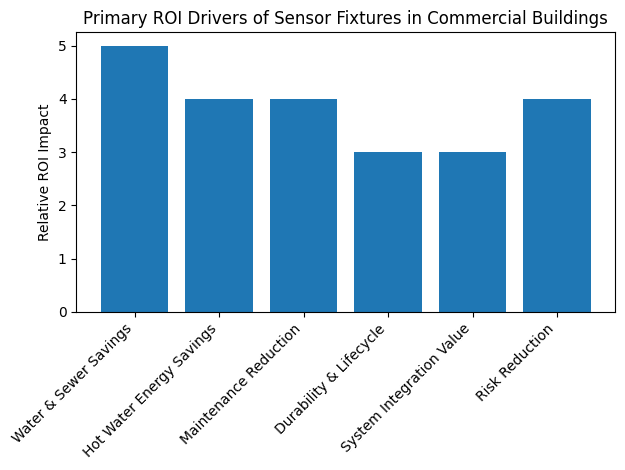
Where the Actual Origin of ROI is
Sensor fixtures generate value through a limited set of quantifiable mechanisms. If these mechanisms are found out early in the design, then teams are able to write clearer specifications and avoid product selections that underperform in the real world.
Controlled delivery of water and sewer costs reduction
In manual faucets, the actual use is often above design assumptions. Users most always leave the water running while soaping, cleaning, or stepping away. Sensor faucets save unnecessary run time by delivery of water only when hands are present or through the application of a controlled metering profile.
This will be particularly effective in those buildings that have a high occupant turnover, including schools, airports, stadiums, healthcare clinics, and government facilities. Long-term, this reduction in excess flow will be directly reflected in reduced water and sewer charges.
For projects pursuing documented efficiency performance, choices should meet EPA WaterSense standards for commercial lavatory faucets. Guidance and program criteria in support of this may be found at:

About this chapter: This chapter includes general information about grey water and rainfall catchment systems, followed by specific details for both grey water and rainfall catchment systems related to system design, materials, and requirements for rainwater collection storage tanks and similar facilities. Volume II: Water Conservation. becomes the Florida Water Star program developed by the Florida Department of Environmental Protection.
Gray water reclaimed water is untreated wastewater that has not come into contact with toilet waste. Gray water includes water that has drained from any combination of sinks, showers, bathtubs, clothes washing machines, or dishwashers. Gray water systems reduce the amount of potable water demanded from municipal water supplies or groundwater aquifers for irrigation purposes.
In addition to conservation, gray water use offers an alternative strategy for areas experiencing high population growth coupled with limited water resources and wastewater infrastructure. Systems using gray water offer economic, social, and environmental advantages by providing new sources of irrigation water for crops, gardens, and landscaping.
State and local regulations may vary greatly when it comes to gray water systems, and may be dependent on factors related to public health concerns. Examples of successful gray water system applications include schools, singleand multi-family residential buildings, resorts, restaurants, office buildings, parks and recreation facilities, and highway rest stops.
For example, gray water collected from lavatories, sinks, and drinking fountains in a school might be used to irrigate an adjacent playing field and to recharge an aquifer. ENVIRONMENTAL BENEFITS Gray water reclamation is one component of a multifaceted approach to safely manage wastewater and conserve potable water.
Potable water savings through gray water reclamation can dramatically reduce wastewater generation. The purpose of this document is to present the state of the art for gray water system design, taking into consideration the inherent risks and the need for the responsible use of the reclaimed water.
Gray water encompasses wastewater that has not come into contact with toilet waste. Gray water includes wastewater that has drained from any combination of sinks, showers, bathtubs, clothes washing machines, or dishwashers.
Design teams should confirm the applicable WaterSense specification version at the time of submittal since criteria are periodically updated.
Hot water energy reduction driven by secondary savings
Most commercial lavatories provide tempered or warm water. Reduced run time also lowers hot-water draw, reducing energy use at the water-heating plant and cutting distribution losses.
For centralized systems, even nominal hot water demand reductions have been known to enhance system stability and reduce potential boiler or indirect water heater short cycling. In electrified, or all electric buildings, reduced hot water demands can also support peak load management goals.
Savings of hot water are not automatic. Specifications should clearly address how temperature is controlled including:
- Location of mixing control, whether at the fixture, group level or central system
- Maximum outlet temperature limits and anti-scald protection
- Response time targets to minimize user frustration and water waste
- Access to service for mixing components without having to shut down entire groups of restrooms
Improvements in maintenance and durability
The owners often realize ROI first by way of fewer maintenance calls. Eliminating several common failure modes of manual faucets, sensor fixtures virtually remove broken handles and loose cartridges, and continuous running caused by user error.
At the same time, sensor fixtures introduce electronics, solenoid valves, and power components. The business case for ROI rests on specifying durability and serviceability, not just “touchless” operation.
Supply fittings shall be in conformance with recognized standards such as ASME A112.18.1 and CSA B125.1. Referenced information for the following standards is listed at:
Specifications should also stipulate the expectations for access to the component, standard replacement parts, and vandal resistance when operating in public or unsupervised environments.
Accessibility and Code Compliance Considerations
Sensor fixtures can simplify compliance with operable parts requirements since they eliminate grasping, pinching, or twisting at the point of use. However, accessibility compliance is never automatic.
Clear floor space, reach ranges, knee and toe clearance, and approach requirements remain applicable. The placement of the lavatory and the geometry of the fixture should be reviewed against the 2010 ADA Standards for Accessible Design available at:
For projects in California, CALGreen introduces mandatory water efficiency requirements for nonresidential buildings. These provisions are enforced alongside the plumbing code and should be reflected in both product selection and documentation.
Official CALGreen references and summaries of water efficiency are provided in:
System Integration as an ROI Multiplier
Replacing fixtures alone captures water and maintenance savings. Planning for data visibility and system integration can unlock additional operational value.
What integration ready means in practice
Large building owners are increasingly seeking insight into restroom usage and fixture performance. Common use cases for data include:
- Usage trends to optimize cleaning schedules
- Alerts for abnormal flow indicating leaks or stuck valves
- Battery health and power fault reporting
- Downtime risk identification for critical restrooms
Early coordination with the BAS or facilities technology group is important. BACnet continues to be the most deployed open protocol for building automation systems. Background Information The following hyperlink provides background information and governance:
For broader guidance on specifying controls scope and documentation, ASHRAE Guideline 13 provides helpful framework:
Following are integration risks to manage:
Common problems that damage ROI include the following:
- No clear ownership of operational data
- Undefined cybersecurity requirements for the connected device
- Commissioning of sensor timing, range, and shutoff logic not performed
The sensor fixtures should be treated as a small controls system with defined sequences, testing, and documentation.
Specification Considerations for AEC Teams
Owners achieve better results when performance-based requirements are clearly defined in Division 22 and coordinated with electrical and controls sections.
Performance and compliance
ADA accessibility requirements for location and approach of toilet rooms
Water efficiency targets aligned with WaterSense or local code requirements
CALGreen compliance documentation – applicable projects
Durability and maintainability
- Compliant to ASME A112.18.1 and CSA B125.1
- Minimum cycle life expectations from solenoids and electronics
- Vandal resistance requirements for public toilets
- Standardized parts strategy across facilities
Power Strategy
- Clear rationale for battery versus hardwired power
- Battery life reporting and failure behavior requirements
- Service access to power supplies and wiring
Controls and water management
- Adjustable limits of detection range
- Configurable shutoff timing for handwashing and cleaning
- Coordinated temperature control and anti-scald strategy
Translating Performance into an ROI Model
A credible ROI model typically includes all or most of the following components:
- Baseline lavatory usage based on occupant load and operating hours
- Expected reduction in run time, compared to using manual fixtures
- Local water and sewer utility rates
- Estimated hot water fraction and energy cost
- Difference in the cost of maintenance among manual and sensor fixtures
- Value of risk reduction from avoided overflows, vandalism, and downtime
The financial case is more easily validated and sustained over the life of the building when sensor fixtures are specified as part of an engineered system rather than a cosmetic upgrade.
Summary table
| Topic | What it covers | ROI driver | Key references |
|---|---|---|---|
| Water and sewer savings | Controlled flow and reduced runtime | Lower water and sewer charges | EPA WaterSense |
| Hot water energy savings | Less hot water draw and distribution loss | Lower heating energy and steadier plant operation | |
| Maintenance and durability | Fewer manual failure modes, but electronics add service needs | Fewer service calls and downtime if specified well | ASME A112.18.1 · CSA B125.1 |
| Accessibility and code | Touchless helps operable parts, not full compliance | Reduced compliance risk | 2010 ADA Standards · CALGreen |
| Integration and controls | BAS visibility, commissioning, and data ownership | Operational multiplier and early issue detection | BACnet · ASHRAE 135 · ASHRAE Guideline 13 |
| ROI model inputs | Usage baseline, utility rates, hot water fraction, maintenance delta, risk value | Validated lifecycle ROI |
No responses yet