
Restroom Fixture Checklist for LEED, WELL & Fitwel
Commercial and institutional restrooms sit at the intersection of water performance, accessibility, operations, and occupant health. This checklist supports architects, engineers, and specifiers who need defensible criteria and verifiable outcomes—beyond marketing claims—when aligning fixture selections with LEED, WELL, and Fitwel goals.
Restroom fixture specifications influence indoor water use reduction, accessibility compliance, cleaning protocols, maintenance cost, and occupant health verification pathways. The strongest outcomes come from mapping fixture selection to enforceable codes first, then layering certification documentation requirements from LEED, WELL, and Fitwel.
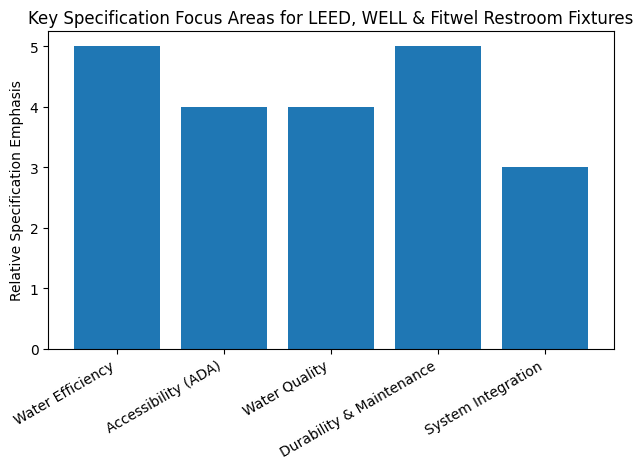
Use the sections below to establish the baseline, define standards compliance, and assemble a closeout package that supports certification review and long-term facility operations.
Establish the Regulatory and Certification Baseline
Confirm Accessibility Scoping Early
Accessibility standards define minimum scoping and technical criteria for restroom fixtures. Coordinate clear floor space, reach ranges, operable parts, mounting heights, and knee/toe clearance early to avoid construction conflicts and late redesign.
Where state or local accessibility provisions exceed ADA, the most restrictive requirements should govern.
Align Plumbing Code + Green Code Overlays
Confirm fixture flow rates and flush volumes against the adopted plumbing code. In jurisdictions like California, CALGreen adds mandatory and voluntary criteria beyond base code—particularly for water efficiency.
Even outside California, CALGreen thresholds are often used as owner performance benchmarks.
Map Fixture Selection to LEED Documentation
LEED Indoor Water Use Reduction credits rely on baseline calculations and verified performance. Fixture schedules should document rated flow/flush values at relevant test pressures, sensor operation modes, and applicable standards. Each line item should support LEED calculator inputs to reduce gaps during review.
Plan Sub-Metering & Verification (When Required)
If owners require ongoing monitoring, fixtures and controls should support submetering, stable set points, accessible isolation valves, and non-invasive verification methods that align with commissioning protocols.
Specify WaterSense and Performance Standards Together
Use WaterSense as a Qualification Baseline
WaterSense provides independent efficiency and performance verification for applicable fixture categories. Specifications should reference the correct product category and require certification documentation for submitted products.
WaterSense does not address structural integrity, material durability, or long-term reliability on its own.
Reference ASME and CSA Performance Standards
Division 22 specifications should reference applicable performance and safety standards. For faucets and fittings, use ASME A112.18.1 / CSA B125.1. For vitreous china plumbing fixtures, use ASME A112.19.2 / CSA B45.1.
Require standard-specific declarations and third-party listings/test documentation when available.
WELL and Fitwel Criteria Through Fixture Design and Operations
Support WELL Water Access + Quality
WELL emphasizes potable water quality and occupant access. Restroom fixture materials and plumbing design can influence stagnation risk and commissioning requirements. Coordinate fixtures with water testing and flushing plans to support verification.
Enable Fitwel Water Management + Maintenance
Fitwel supports water management and testing programs. Select fixtures for maintainability: accessible shutoffs, serviceable components, and clear documentation. Reduce dead legs and support routine flushing to mitigate water quality risks in low-use restrooms.
Consider long-lasting finishes suited to institutional cleaning protocols.
Match Materials and Finishes with Cleaning Protocols
Fixtures in schools, healthcare, transit, and other high-use settings face constant cleaning with aggressive agents. Verify finish compatibility with the owner’s cleaning chemicals and procedures. Favor designs with fewer seams, fewer exposed fasteners, and fewer hidden leak paths to reduce maintenance and hygiene risk.
Standardize Components to Reduce Lifecycle Costs
Standardize cartridges, sensor modules, solenoids, and power supplies to simplify maintenance across restrooms. Specifications should require recommended spare parts lists and preventive maintenance intervals as part of closeout.
Assess System Integration and Risk Management
Define power, failure behavior, monitoring requirements, and leak risk mitigation before procurement.
Define Power + Failure Behavior
Document power strategy for sensor-operated fixtures (battery vs hardwired), failure mode behavior, manual override, and protection against nuisance activations. This supports usability and reduces service interruptions.
Harmonize Data + Monitoring Requirements
Define integration requirements for BMS or water analytics: data points, trend retention, communication protocols, commissioning responsibilities, and cybersecurity constraints. Even without full integration, consider group-level isolation and leak detection strategies to reduce damage and water loss.
Assemble a Certification-Ready Submittal and Closeout Package
A strong closeout package supports certification review and long-term operations.
- Fixture schedules with rated performance data
- WaterSense documentation where applicable
- ADA drawing and cut sheet compliance documentation
- Declarations of compliance with ASME and CSA standards
- Commissioning and flushing procedures
- O&M manuals with guidance on cleaning compatibility
- Water management and quality testing alignment for WELL and Fitwel
Conclusion
Specifying restroom fixtures with LEED, WELL, and Fitwel certification in mind is a systems-based process. Beyond water efficiency, fixtures must enable accessibility, ensure durability, support maintainability, and provide verifiable performance. Specifications aligned with recognized standards and operational expectations help deliver restroom environments that meet certification objectives while sustaining long-term functional value.
Restroom Fixture Checklist for LEED, WELL & Fitwel
| Category | Standards / Programs | Spec Checklist |
|---|---|---|
| Accessibility | ADA 2010 | Confirm clearances, reach ranges, mounting heights, operable parts. |
| Water Efficiency | LEED, WaterSense, CALGreen | List rated flow and flush values with test conditions and documentation. |
| Performance Standards | ASME A112.18.1, ASME A112.19.2, CSA equivalents | Require compliance declarations and verified performance standards. |
| Water Quality | WELL v2, Fitwel | Specify materials and commissioning/flushing approach to reduce stagnation risk. |
| Durability | Owner O&M requirements | Confirm finish and component resistance to disinfectants and frequent use. |
| Maintainability | Facility standards | Standardize parts, require spare parts lists, ensure service access. |
| Controls and Power | Project electrical criteria | Define battery/hardwired power, failure behavior, override capability. |
| Integration and Monitoring | Owner BMS / FM systems | Define required data points, commissioning scope, leak risk mitigation. |
| Closeout | LEED, WELL, Fitwel documentation | Require schedules, cut sheets, O&M manuals, and testing/flushing plans. |
Verified reference links (clean button list)

No responses yet