
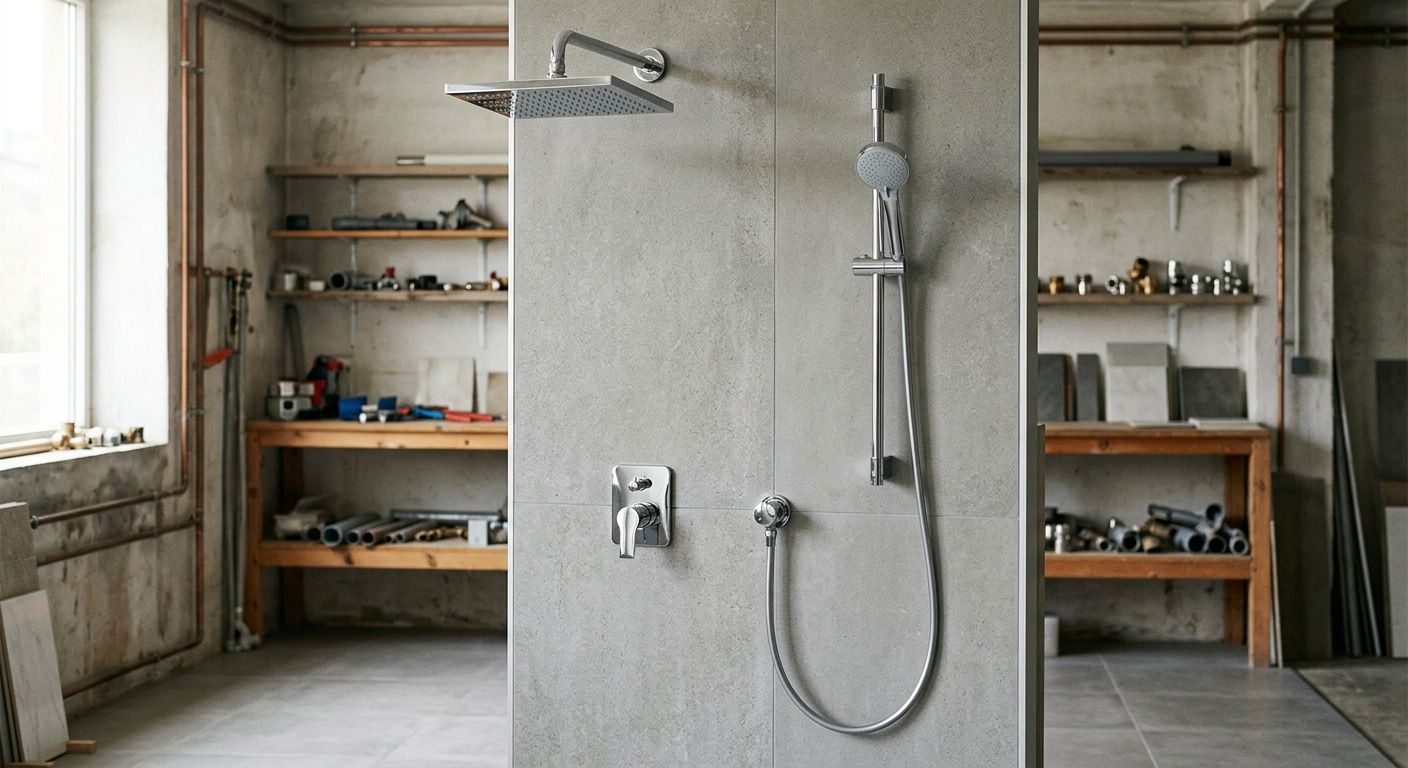
The choice between a rain head and a handheld comes down to your ceiling height, your rough-in, and what the shower needs to do for the people using it. A rain head is a fixed-position, low-pressure format that depends on a clean overhead rough-in and enough ceiling height to get the drop right. A handheld is a flexible, task-oriented fixture that solves for bathing kids, washing a dog, cleaning the stall, or seated use. Pick the one that matches your layout constraints first, then decide whether the budget and the wall space support both.
The Design Concept This Decision Serves
Say you are running two projects: a small wet room, roughly 5 by 7 feet, with a linear drain and no tub, and a standard tub-shower combo in a secondary bath, roughly 60 inches long with a 3-wall alcove. The wet room is built for one adult, daily use, minimal hardware, and a architectural ceiling-mounted fixture. The tub-shower combo has to serve a wider range of users, from a quick shower to bathing a toddler, and needs the flexibility a fixed head cannot provide alone.
These two spaces are not interchangeable, and the fixture choice should follow from how each room is actually used, not from what looks better on a spec sheet.
Ceiling Height and Rough-In Constraints
Rain heads are gravity-fed by design intent even though they run on standard supply pressure, and that means the drop from the showerhead centerline to the user’s shoulders matters. The standard rough-in height for a ceiling or high-wall rain arm is 80 inches to the showerhead centerline, which assumes a ceiling of at least 84 to 96 inches in that section of the bath. If your ceiling is lower than that, or if there is a soffit, duct, or joist running through the exact spot you want the fixture, a rain head becomes a framing problem before it becomes a plumbing one.
Check these before you commit to a ceiling-mount rain head:
- Clear ceiling height above the stall or tub, measured at the exact point of installation, not just at the room’s tallest point
- Joist direction and spacing, since ceiling-mount arms need blocking between joists for the mounting flange
- Whether the supply line can come down through the ceiling cavity without rerouting HVAC or electrical
- Wall-mount rain arm as a fallback, which drops the head forward from the wall at standard tub-spout height plus an extended gooseneck, avoiding ceiling work entirely
A handheld sidesteps almost all of this. It mounts to a slide bar or a fixed bracket at a standard wall height, typically 48 to 80 inches depending on who is using the shower, and it connects through the same 1/2-inch NPT thread size used on any standard shower arm. No ceiling access, no blocking, no drop calculation. If you are working in a renovation with an existing ceiling you do not want to open up, the handheld is the fixture that respects the constraint.
Flow Rate and Pressure Tradeoffs
Every WaterSense-certified showerhead sold today, rain or handheld, is capped at 2.0 GPM (7.6 LPM), which is already below the federal maximum of 2.5 GPM. That cap applies to the fixture, not the format, so a rain head and a handheld draw the same volume of water at the same pressure. The difference is how that volume gets distributed.
Rain heads spread flow across a wide face, often 8 to 12 inches in diameter, which lowers the effective pressure per square inch of coverage. On a home with municipal pressure under 45 psi, a large-format rain head can feel weak even though it is delivering full flow. Handhelds concentrate the same flow through a smaller face, so they feel stronger at the same GPM and same pressure. If your project is on a well system or an older home with marginal pressure, that difference is worth flagging to the client before they fall in love with a 10-inch rain head that will underperform on their supply.
Valve and Diverter Options Compared
Running one head off one valve is straightforward: a standard pressure-balance or thermostatic valve with a single outlet handles either a rain head or a handheld with no added hardware. Running two heads, which is what the tub-shower combo in this example needs, requires a valve with a diverter that can route flow to one outlet at a time or split it.
| Valve type | Function | Best for |
|---|---|---|
| Single-function valve | One outlet, one head, no diverter | Wet room with a single rain head, no handheld |
| Three-function diverter valve | Routes flow to rain head, handheld, or tub spout, one at a time | Tub-shower combo needing both a fixed head and a handheld without running both simultaneously |
| Thermostatic valve with integrated diverter | Maintains set temperature across multiple outlets, can run two heads at once depending on model | Primary bath where both heads may run together, or where separate volume controls are wanted |
For the tub-shower combo, a three-function diverter valve is the practical minimum. It lets the user switch between tub fill, handheld, and rain head without adding a second valve body or opening up more wall for rough-in. A thermostatic valve with simultaneous operation is the upgrade path if the client wants to run both heads at once, but it adds cost and requires more wall depth for the valve body, so confirm stud depth before specifying it in a 2×4 wall.
Fixture Picks for Two Layouts
For the wet room: a ceiling-mount rain arm at 80 inches to centerline, an 8-inch rain head rated at 2.0 GPM, and a single-function thermostatic valve. No handheld, no diverter complexity, because the room is built for one user and the ceiling height supports the drop without a soffit conflict. The linear drain and single-fixture layout keep the wall clean, which was the point of the wet room concept in the first place.
For the tub-shower combo: a wall-mount slide bar handheld at 72 inches, paired with a fixed rain head on a wall-mount gooseneck arm rather than a ceiling mount, since the alcove ceiling height did not clear 84 inches at the shower location. Both run off a three-function diverter valve, letting the household switch between tub fill for bathing a toddler and the handheld or rain head for adult use. This is the layout where the handheld earns its spot on the wall, not as a luxury add-on but as the fixture that makes the room work for more than one person.
When to Spec Both Heads
Spec both when the room has more than one primary user with different needs, when the ceiling height supports a rain head without compromise, and when the budget covers a three-function or thermostatic valve plus the added rough-in for two supply points. Do not spec both as a default upgrade in every primary bath. In a single-user wet room with adequate ceiling height, a rain head alone is the cleaner, more considered choice, and adding a handheld only adds hardware and cost without solving a problem the room actually has.
Before You Order
Measure ceiling height at the exact fixture location, not just the room average, and confirm joist layout before specifying any ceiling-mount arm. Check static water pressure at the fixture location if the home is on a well or has known pressure issues, since that number should drive head size more than the finish or brand. If two heads are going on one wall, confirm the valve body depth against actual stud depth before rough-in, and if the answer to any of these is unclear, bring in a plumber to verify rough-in dimensions before the fixtures are ordered, not after.