
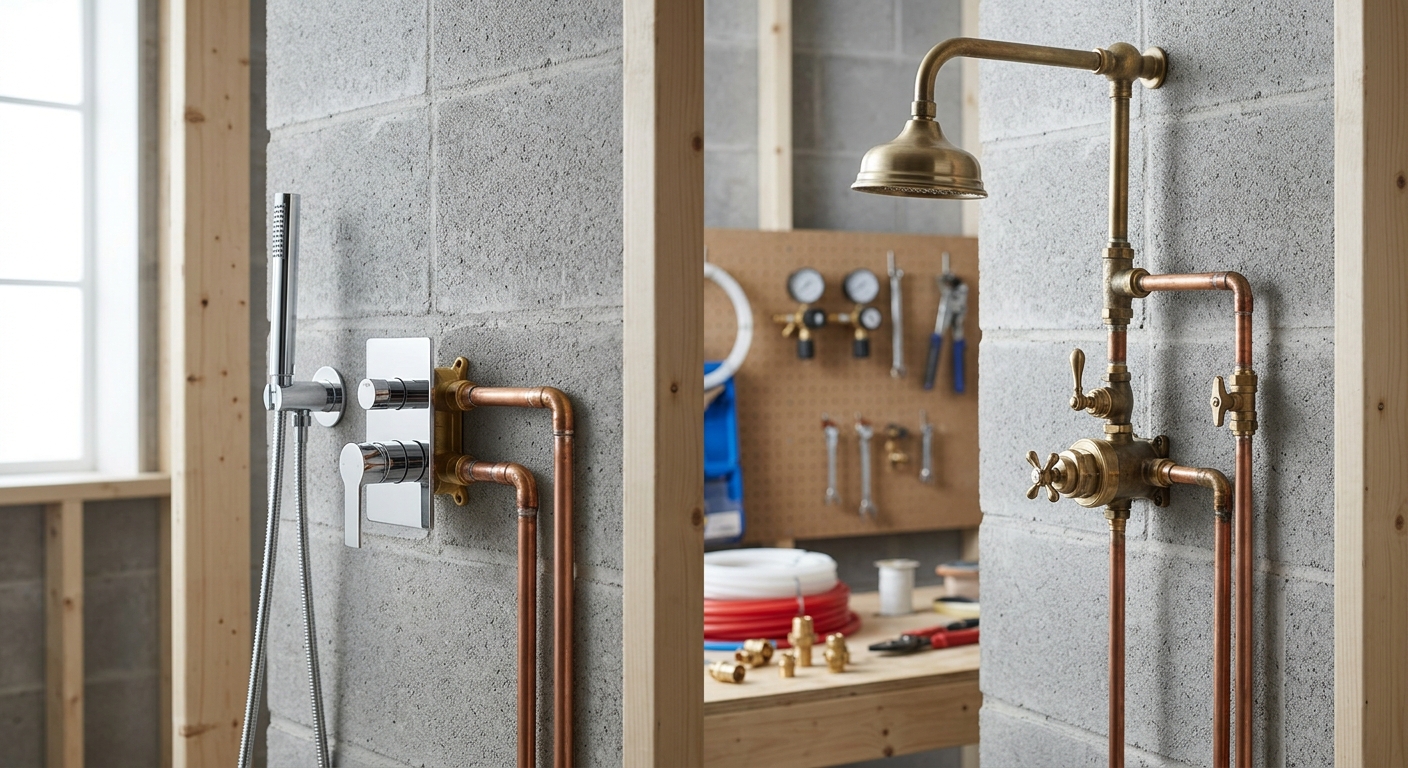
Pick minimalist or traditional before you touch a spec sheet, because the decision sets your valve rough-in depth, cartridge type, and escutcheon size well before anyone picks a trim finish. Switching profiles after rough-in means opening the wall. Get the profile decision locked at framing, not at trim selection.
Starting From a Single Design Concept
Say the concept is a primary bath with a freestanding tub, a curbless shower, and a wall-hung vanity. That’s the mood board. But “minimalist” and “traditional” aren’t just finish choices at this stage, they’re plumbing choices. A minimalist concept pushes you toward concealed valves, slim escutcheons, and ceramic disc cartridges. A traditional concept points to exposed or semi-exposed trim, deep round escutcheons, and often compression cartridges if you’re matching a period look. Once the plumber sets boxes and stub-outs based on one path, reversing course means demo.
This is why the fixture schedule needs to exist before drywall, not after. The GC needs rough-in depth and connection type from you at framing, and that number comes straight from the profile decision you made on the mood board.
Minimalist Profiles: Trim and Valve Specs
Minimalist trim reads as flat plates and thin rings against the tile, which means the valve body sits closer to the finished wall and the cartridge has to be compact enough to fit a shallow valve box. Most concealed thermostatic or pressure-balance valves built for slim trim have a rough-in depth of 2.5 to 3.5 inches from the stud face to the valve body, with the escutcheon plate finishing flush or near-flush at 4 to 6 inches in diameter. That shallow depth is only possible because these valves almost always run ceramic disc cartridges, which are compact, don’t need deep internal travel, and hold tight tolerances in a small housing.
Ceramic disc cartridges work by rotating two polished discs against each other to control flow and mix. They’re low-maintenance, resist mineral buildup better than rubber-seal designs, and give a crisp quarter-turn or lever action that suits a minimal handle profile. The connection at the valve body is still standard 1/2 inch NPT, so the rough-in plumbing itself doesn’t change. What changes is the depth and footprint of the valve the NPT thread is attached to.
Traditional Profiles: Trim and Valve Specs
Traditional trim carries more visual weight on purpose, so the hardware behind it can be bulkier without looking wrong. Exposed or semi-exposed traditional valves often use compression cartridges, which rely on a washer seated against a valve seat to shut off flow. Compression cartridges need more internal depth and travel than ceramic disc designs, and the valve bodies that house them are correspondingly larger. Expect rough-in depths at the deeper end of that 2.5 to 3.5 inch range, sometimes a touch more depending on the manufacturer’s valve platform.
The escutcheon follows the same logic. Traditional round escutcheons typically run 6 to 8 inches in diameter, deep enough to cover a wider valve body and give the plate some dimensional presence, often with a stepped or beveled edge rather than the flat minimalist ring. If you’re sourcing reproduction or true period hardware, look at period style faucets in antique brass or similar living finishes, since those product lines are built around the deeper valve bodies and wider escutcheons that traditional profiles need. The NPT thread size at the supply connection stays 1/2 inch here too, same as the minimalist side, so plumbers aren’t dealing with different pipe sizing, just different valve geometry behind the wall.
Rough-In Depth That Limits Your Options
Rough-in depth is the number that actually constrains your fixture choices later, more than finish or handle style. If your wall cavity only gives you 2.5 inches of clear depth once insulation and vapor barrier are in, you’ve ruled out some traditional valve platforms before you’ve picked a single trim kit. Conversely, if you’ve framed a deep chase wall for a traditional valve and later decide to go minimalist, you’re not blocked, but you’ll want to confirm the slim trim kit’s included extension or spacer works with that depth so the escutcheon still sits flush.
| Spec | Minimalist Profile | Traditional Profile |
|---|---|---|
| Valve rough-in depth | 2.5 to 3 inches typical | 3 to 3.5 inches typical |
| Escutcheon diameter | 4 to 6 inches, flat | 6 to 8 inches, stepped or beveled |
| Cartridge type | Ceramic disc | Compression (often), ceramic disc on some lines |
| Supply connection | 1/2 inch NPT | 1/2 inch NPT |
Always get the exact rough-in dimension from the manufacturer’s spec sheet for the specific valve you’re installing, since these ranges vary by brand and model. Framing to a rough estimate instead of the actual spec sheet is one of the more common callbacks on custom bath jobs.
Mixing Profiles Without Breaking Cohesion
You can mix minimalist and traditional elements in one bathroom, but it works best when you mix at the level of material and form, not at the level of valve mechanics. A freestanding tub filler with a traditional silhouette can still run a ceramic disc cartridge and a slim-adjacent escutcheon if you choose a transitional product line built that way. What doesn’t work is forcing a compression-cartridge traditional valve into a 2.5 inch cavity designed for slim trim, or trying to make a flat 4 inch plate cover a deep traditional valve body meant for an 8 inch escutcheon.
If the concept calls for a traditional pedestal sink faucet next to a minimalist concealed shower valve, that’s a defensible mixed scheme as long as each fixture’s rough-in is specified and framed independently. The cohesion comes from finish, proportion, and handle language across the room, not from forcing every valve into identical hardware.
Final Fixture Schedule Walkthrough
Before the fixture schedule goes to the GC, confirm these for every wet location in the room:
- Valve rough-in depth from the manufacturer’s spec sheet, not a general range
- Escutcheon diameter and whether it’s flush-mount or standoff
- Cartridge type, since it determines maintenance access and handle feel
- Supply connection size, standard 1/2 inch NPT unless the spec says otherwise
- Wall cavity depth at the actual stud location, confirmed after insulation
Walk the framed walls with the plumber before drywall and hold the actual valve body up to the rough opening if you can. It takes ten minutes and it catches depth mismatches while they’re still cheap to fix. If you’re working with a reproduction or specialty traditional line, call the manufacturer or distributor directly to confirm rough-in depth rather than relying on a generic cut sheet, since these can vary more between traditional product lines than they do between modern minimalist ones.