
Hotels, resorts, convention centers, and mixed-use hospitality developments are making a rapid shift towards replacing traditional faucets with sensor-activated faucets. The intent is to enhance cleanliness, water conservation, and code-compliance. This report provides key parameters on constraints, specifications, and requirements for design, so that reliable, code-compliant, and futurist designs for touchless faucets are achieved.
Context: Why Hospitality Facilities Are Transitioning to Touchless Systems
Touchless faucet retrofits are typically driven by three combined pressures: hygiene expectations, water-efficiency targets, and compliance with accessibility and plumbing standards. For architects and engineers, the decision is less about “trend” and more about meeting measurable performance and regulatory criteria.
The governing frameworks shape requirements for water use, accessibility, safety, and mechanical reliability—especially in high-occupancy public restrooms and guestroom applications.
Existing Conditions and Retrofit Design Constraints
Basin, Deck, and Mechanical Condition Assessment
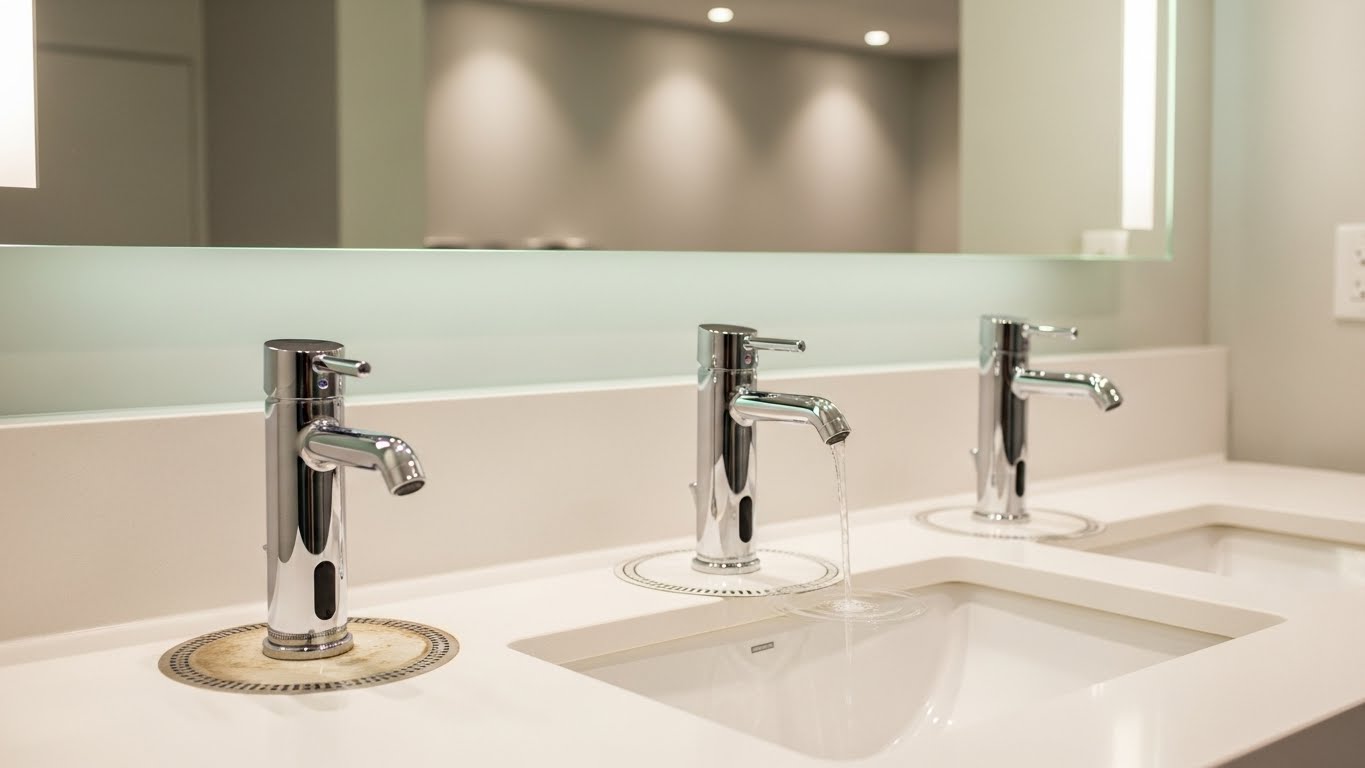
Retrofit conditions—especially in older hospitality properties—are highly variable. Existing installations often include:
- Single-hole or 4" centerset manual faucets
- Manual blending by angle stops
- No under-counter electrical infrastructure
- Inconsistent supply pressures
- Casework with limited clearance or access panels
Design teams should document deck thickness, basin geometry, hole patterns, supply line diameters, valve accessibility, and spatial constraints affecting control box placement and ADA compliance.
ADA and Accessibility Requirements
Touchless faucets make it easier to reach and turn things, but parts that are under the counter must not get in the way of the ADA’s clearance zones. Pay close attention to:
- Knee and toe clearance limitations
- Forward and side reach ranges
- Operability requirements for any user-adjustable controls
Performance Outcomes: Flow Control, Hygiene, and End-User Reliability
Flow Rates and Conservation Benchmarks
Commercial touchless faucets in hospitality applications typically target 0.50–1.20 gpm depending on use case (guestrooms vs. public restrooms). The most relevant benchmarks and product criteria include WaterSense specifications and CALGreen water-efficiency measures.
Hygiene and Operational Reliability
In practice, performance gains depend on commissioning—not simply installation. Key commissioning steps include:
- Adjusting sensor range based on basin geometry
- Verifying run-on time and detection thresholds
- Confirming spout projection to reduce splash and false triggers
Durability, Mechanical Integration, and Material Selection
Material and Valve Requirements
High-traffic hospitality restrooms require components engineered for long duty cycles. Typical specification expectations include:
- Faucet bodies in cast brass or stainless steel
- High-cycle solenoid valves or ceramic-disc designs
- Weather-tight, gasketed control boxes
Primary plumbing supply fitting standards commonly referenced:
Power Strategies: Battery, Hard-Wired, or Hybrid
Retrofit constraints often determine feasible power options:
- Battery systems → simplest installation, but require periodic replacement
- Hard-wired low-voltage → stable performance, but requires routing cables/conduits
- Hybrid configurations → common across large hospitality portfolios to balance uptime and serviceability
System Integration: Mixing, Scald Protection, Controls
Thermostatic Mixing and Temperature Limiting
When you upgrade to touchless faucets, you often have to rethink how you mix hot and cold water, especially to keep the temperature stable and lower the risk of scalding. Some important standards and guidelines are:
5.2 BMS / IoT Integration
Future-ready hospitality designs frequently include provisions for system monitoring and expansion, such as:
- Spare conduits for communication lines
- Space for additional controllers
- Grouped low-voltage wiring pathways
Sustainability, Water Savings, and Life-Cycle Cost Performance
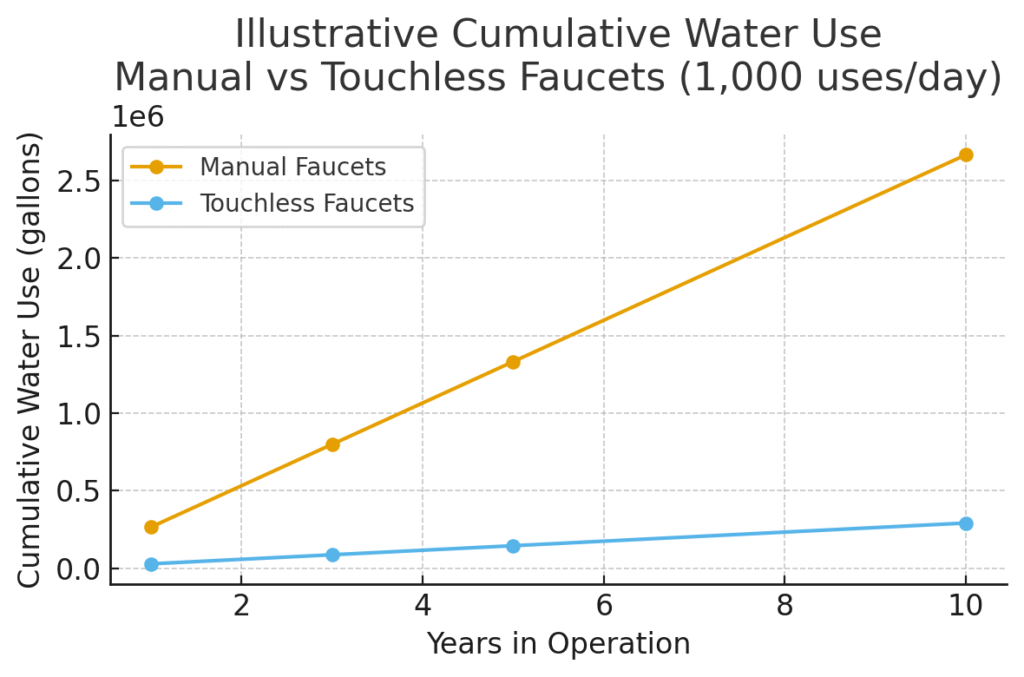
Water Consumption Reductions
Comparisons commonly used in hospitality retrofits illustrate why touchless systems deliver large savings:
- Manual faucet (2.2 gpm, 20 s) → ~0.73 gallons per event
- Touchless faucet (0.5 gpm, 8–10 s) → ~0.08 gallons per event
Cost and Maintenance Outcomes
Touchless retrofits minimize wear on handles and hand-mixing components and thereby minimize the number of service calls and maximize product reliability. Reduced run times also help avoid wasting energy associated with the use of hot water, providing another layer of cost savings beyond the sewer charges.t
Constructability and Phasing
Minimising Operational Disruption
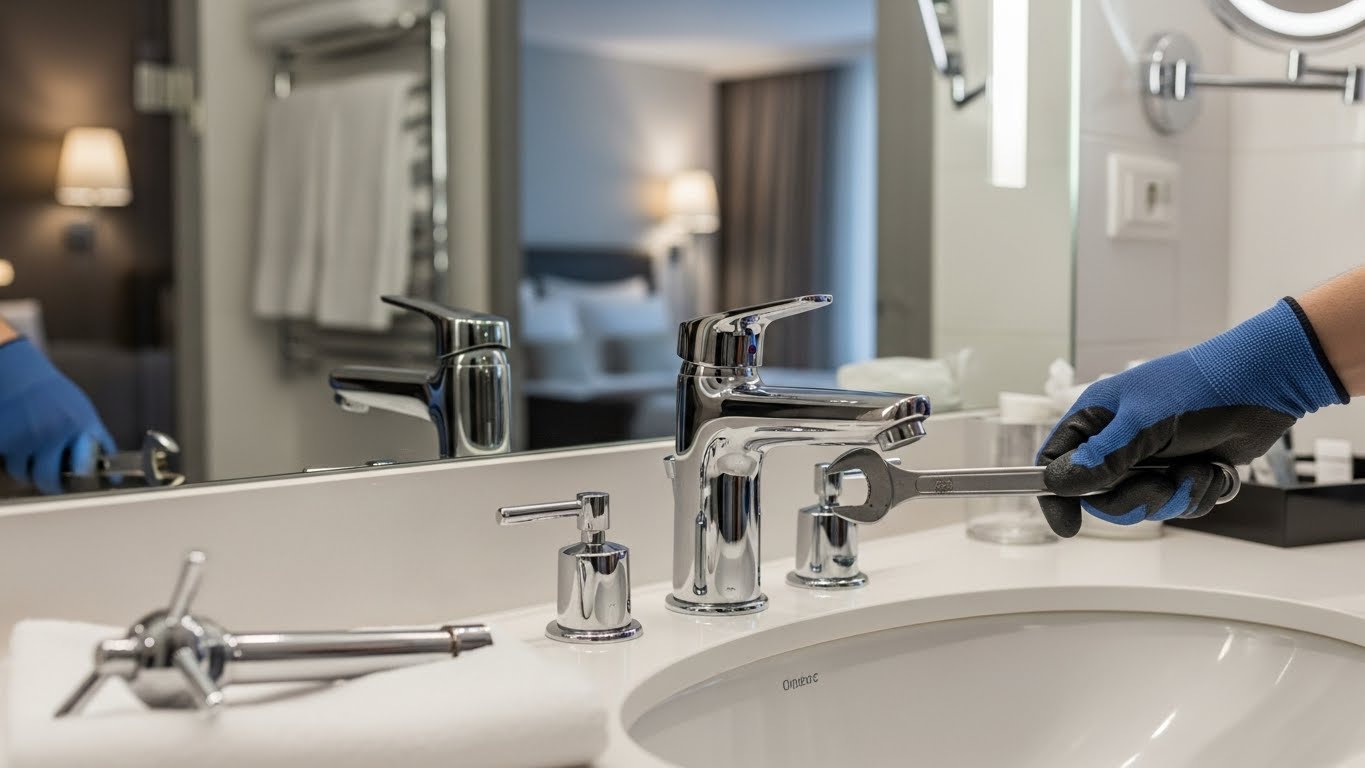
Hospitality facilities rarely shut down, so retrofit implementation often relies on operationally safe sequencing, including:
- Mock-ups to validate fit and cycle behavior
- Zone or guestroom stack sequencing
- Limited shutdown windows aligned with occupancy patterns
Coordination with MEP and Millwork Trades
Successful retrofit delivery requires alignment across disciplines:
- Architectural: casework access + ADA clearances
- Electrical: low-voltage routing + power supply placement
- Plumbing: mixing strategy + temperature limiting + commissioning
Specification Checklist for AEC Teams
A complete touchless faucet retrofit specification should cover both compliance references and technical requirements—so the installed system performs reliably from day one and remains serviceable for the life of the asset.
Standards and Compliance References
- ADA Standards and guidance documents
- EPA WaterSense criteria and product listings
- CALGreen mandatory water-efficiency measures
- ASME A112.18.1 / CSA B125.1 plumbing supply fitting standard
- ASSE 1070 temperature limiting devices standard
Technical Content Elements
- Flow rates and sensor timing targets
- Temperature control + scald prevention requirements
- Material selection and corrosion resistance
- Power supply method and serviceability strategy
- Commissioning: sensor calibration, temperature verification, ADA clearance checks
Conclusion
The process of converting manual faucets to touch-free faucets in commercial settings involves many areas of collaboration related to accessibility, functionality, plumbing standards, electrical support, and long-term functionality. When properly implemented and installed, these projects provide quantifiable benefits in areas related to hygiene, water savings, and cost value while supporting established standards such as ADA, WaterSense, CALGreen, A112.18.1/CSA B125.1, and ASSE 1070.
Most importantly, a touchless retrofit can be structured as a future-ready platform—preserving flexibility for eventual BMS or IoT integration without forcing premature complexity into the first phase of upgrades.
| Topic | Key Point | Main References |
|---|---|---|
| Reason to retrofit | Touchless faucets improve hygiene, save water, and support code compliance in hospitality. | ADA 2010, WaterSense, CALGreen |
| Retrofit & ADA | Designs must fit existing basins/casework while preserving ADA clearances and reach ranges. | ADA 2010, ADA Technical Guidance |
| Water & energy | Touchless uses ~0.08 gal/event vs ~0.73 gal for manual, reducing water and hot-water energy. | WaterSense, EPA Commercial Buildings |
| Hardware & power | Durable brass/stainless bodies and high-cycle valves; battery, hard-wired, or hybrid power per site constraints. | ASME A112.18.1/CSA B125.1, DOE FEMP |
| Safety & controls | Thermostatic/temperature limiting devices and BMS/IoT-ready layouts manage scald risk and monitoring. | ASSE 1070, DOE FEMP Tools |
| Delivery & phasing | Use mock-ups, zone sequencing, and close MEP/architectural coordination to minimize disruption. | DOE FEMP Best Practices |
-
 ada.gov
ADA 2010 Standards for Accessible DesignFederal accessibility standards covering clearances, reach ranges, and operability requirements.
ada.gov
ADA 2010 Standards for Accessible DesignFederal accessibility standards covering clearances, reach ranges, and operability requirements. -
access-board.gov
U.S. Access Board ADA DocumentationSupplemental ADA guidance and documentation useful for design interpretation and compliance review.
-
epa.gov
EPA WaterSense ProgramWater efficiency program and product criteria relevant to faucets and other plumbing fixtures.
-
epa.gov
WaterSense-Labeled ProductsHow to find independently certified WaterSense products and confirm applicable labels and specs.
-
dgs.ca.gov
CALGreen — California Green Building Standards CodeCalifornia’s mandatory measures and guidance for water efficiency and sustainable building performance.
-
asme.org
ASME A112.18.1/CSA B125.1 — Plumbing Supply FittingsCore standard for plumbing supply fittings—often referenced in touchless faucet specifications.
-
csagroup.org
CSA Plumbing Supply Fittings DocumentCSA reference for combined ASME/CSA plumbing supply fitting standards and documentation.
-
assewebstore.com
ASSE 1070 — Water Temperature Limiting DevicesStandard supporting scald risk mitigation through temperature limiting and mixing device controls.
-
energy.gov
DOE FEMP ProgramMethodological guidance for retrofit strategy, performance evaluation, and energy-management planning.
-
energy.gov
DOE FEMP Tools & ResourcesRetrofit tools, templates, and resource libraries supporting lifecycle evaluation and project planning.

No responses yet