
Accessibility, sustainability, durability, and commissioning considerations for commercial and institutional teams
This case study will focus on the planning and execution involved in a 5-star hotel restroom project involving public lobby restrooms, conference and ballroom pre-function areas, and worker facilities. The goals of the owner relative to the project centered not on novelty and appearance but on long-term function and operational success and sustainability.
Right from the onset, the project team was focused on three key performance targets: the compliance of the facility with accessibility standards, water efficiency standards, and recognized standards for plumbing and the building.
Key Sections
Historical Code Mapping and Code Strategy
A code analysis was conducted during the concept design phase. The occupant load for each functional space has been determined. Restrooms have also been defined on the basis of user types and event patterns such as event surges, general public access, and restricted access by building occupants.
Accessibility was addressed as a spatial coordination problem and not treated as an end game of compliance. The layouts were created to comply with the 2010 ADA Standards for Accessible Design, and the clearance solutions were made prior to finish and millwork development.
Chase wall depths were defined early to accommodate carrier, piping, and electrical devices, while still maintaining necessary maneuvering clearance. A typical accessible lavatory detail solved the problem of harmonizing knee and toe clearance, trap protection, sensor location, mirror height, and accessory regions.
Where applicable, ICC A117.1 was referenced as a resource for additional guidance regarding validation of clearances and ranges during detailing.
Specification Development for Commercial Durability
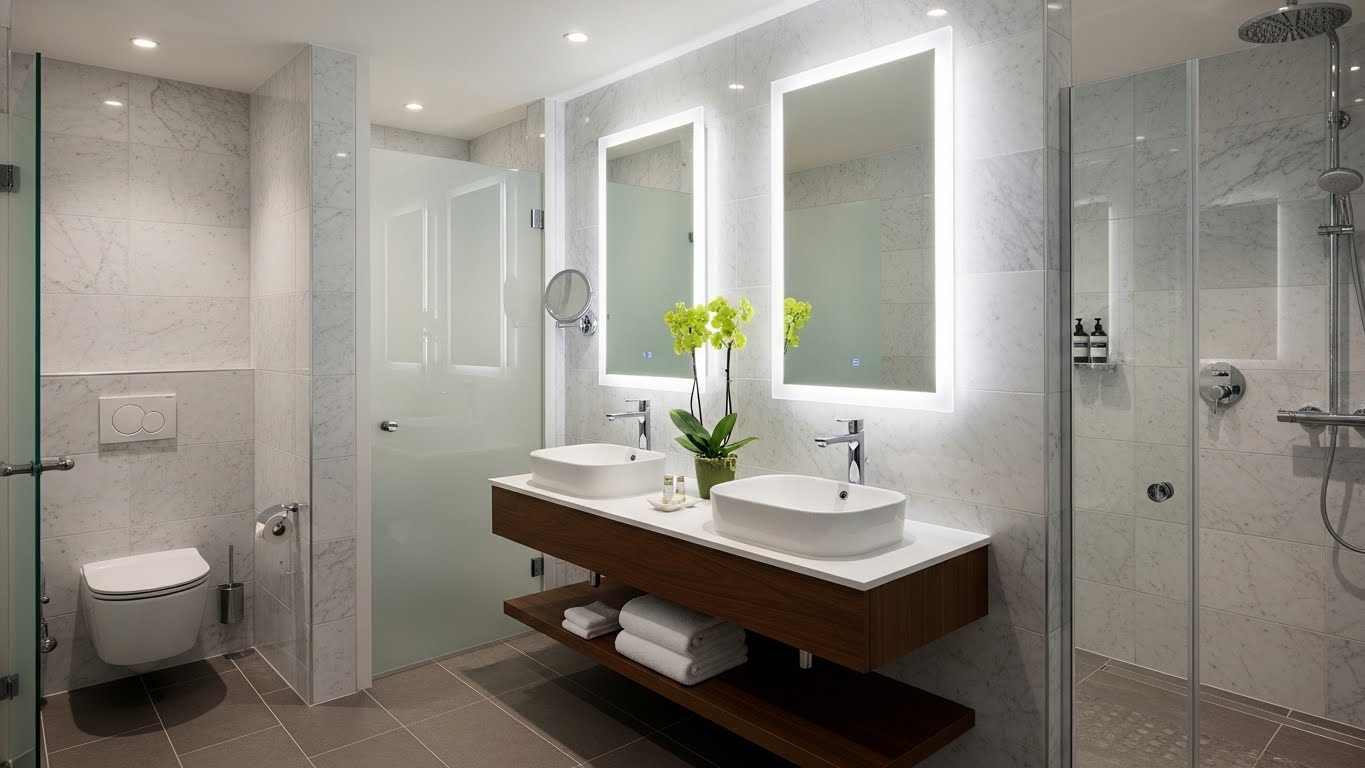
Materials chosen emphasized their performance ability, not aesthetics. For highly trafficked areas in public spaces, specifications called for solid metal components for all points of heavy use, with durable finish selections for corrosion, cleaning agent, and abrasion resistance. Thin-plated plastics eliminated from public restrooms.
Accessories and dispensers had to employ vandal-proof fasteners and hidden mounting. Specified finishing had to address the composition of the finish materials and the recommended agents for cleaning the finishes. This aimed at reducing degradation due to housekeeping.
The plumbing fittings and supply line items were specified in line with recognized performance standards, which included ASME A112.18.1 and CSA B125.1 where applicable. This eliminated confusion that could arise during the submittal process, ensuring that each manufacturer performed similarly to others.
In terms of installation requirements, maintainability was emphasized. Isolation valves, accessible stops, and service clearance were required to enable routine maintenance to be done without affecting adjacent finishes or occupied spaces.
Sustainability and Water Quality
The water efficiency criteria were developed in accordance with WaterSense guidelines issued by the U.S. Environmental Protection Agency for commercial and institutional use. The engineering team did not simply use rated flow performance in evaluating how a water-using product would really perform.
The sensor-activated water fittings have been designed during startup to optimize water conservation and functionality. The range settings for the sensors were optimized to eliminate malfunctions triggered either by reflection or other users in upmarket bathroom design.
When applicable and mandated by jurisdiction or owner, the CALGreen indoor water use requirements were used as a documentation tool. Fixture schedules were considered compliance documents, and submittals were referenced to designated flow rates and levels of performance.
In regions that employ the California Plumbing Code, there was direct reference to code sections during design coordination and submittal in order to achieve consistency between architectural and plumbing aspects.
System Integration Within a Hospitality Setting
Hot water distribution was engineered to emphasize temperature control and reaction speed. Rest room spaces were segmented into separate recirculating circuits. Balancing valves were provided for each rest room area to enable ease of adjusting during commissioning.
Methods of temperature control included central mixing with point-of-use verification to prevent scaling while ensuring a consistent user experience. Insulation integrity and access to balancing devices were considered as controls in the construction process.
When detailing the electronic fixtures and sensor-controlled equipment, there was a need for integration of plumbing, electrical, and low-voltage work. Power points, access points, and control interfaces were all detailed in the contract documents to preclude improvisation at the site.
Submetering of the water was applied with the objective of distinguishing the public toilet water demand from the back-of-house water use. Pulse outputs were linked to the building automation system, and the trend of the consumption and abnormal flows for leakages and defective parts could be depicted by the facilities management team.
Construction Coordination and Mockups
Model-based coordination methods were employed in order to avoid conflicts involving structure, plumbing, electrical, and finish elements. Special focus was given to carrier location, waste height, grab bar blocking, and power routing of hand dryers and sensors.
A full-scale restroom mock-up was used as a functional test bed and not merely as an appearance exercise. The restroom mock-up was to check the ADA clearances, review the splash patterns for specific flow rates, check the sensor performance in actual lighting conditions, and verify maintenance access to the services.
Problems found during the mock-up review stage were addressed in standard detail changes prior to full-scale construction, thus minimizing the possibility of reworks and change orders during the actual construction process.
Commissioning and Long-Term Performance
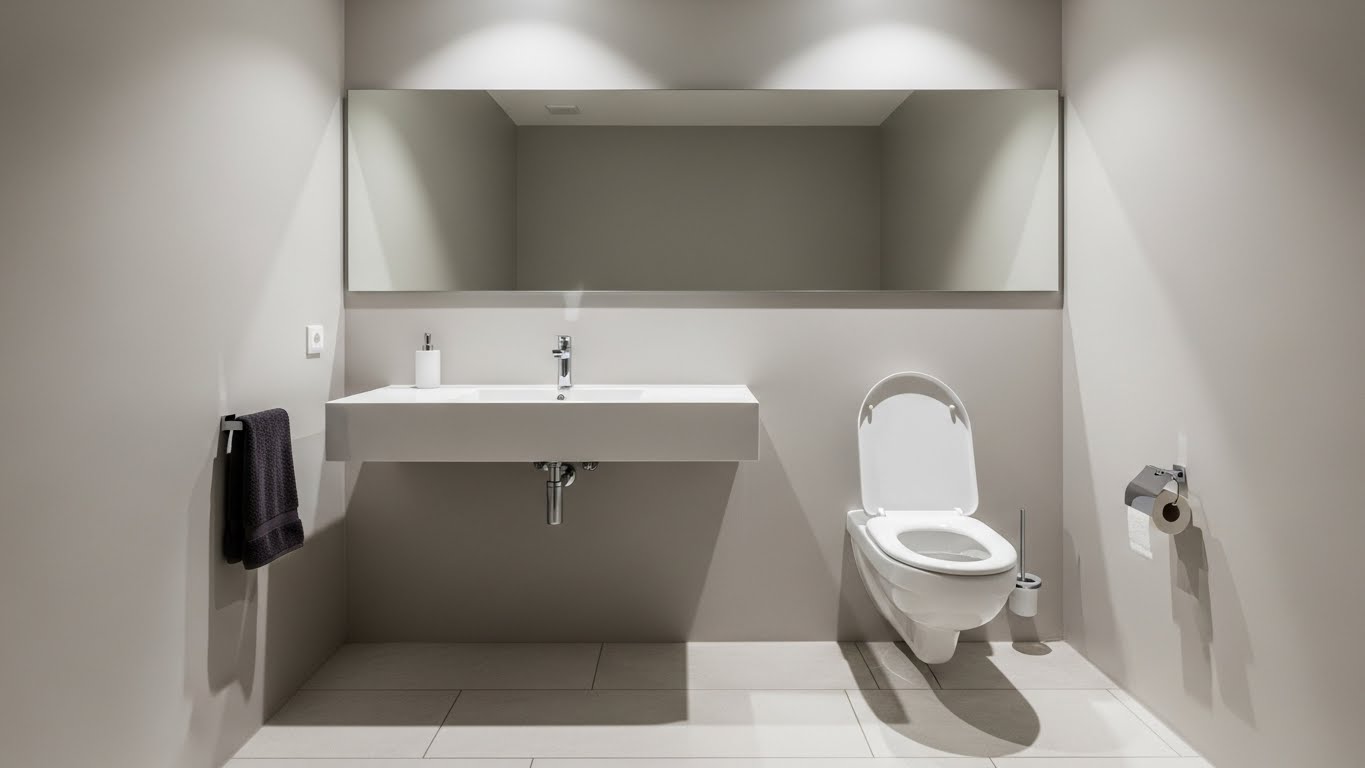
Commissioning involved verifying repeated demonstration of performance for various types of restrooms. Flow rate and flush volume were checked against approved submittals. Functionality of sensors, power options, and timeout specifications were also recorded. Temperature stability and scald protection features were checked for representative fixtures.
The turnover documentation was organized for facilities personnel rather than design intention solely. Operating and maintenance manuals provided suggested spare parts, reset information for electronic items, and inspection intervals for stops, strainers, and valves.
Lessons for Architects and Engineers
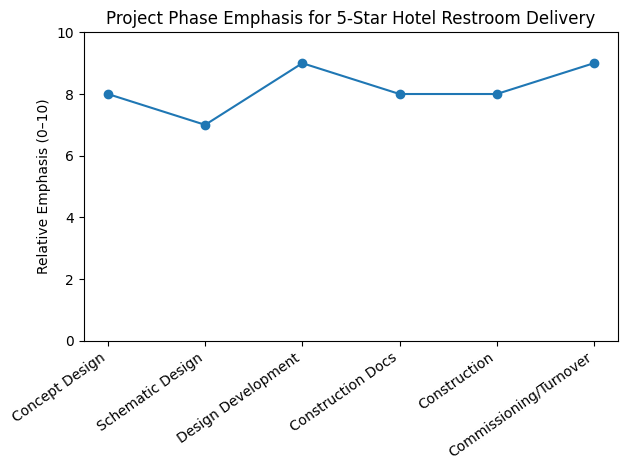
This case example proves a high-level restroom environment is served by technical discipline no less than aesthetic vision. Occasional coordination, specifications conformity with code, and commissioning-related water conservation achievable through commissioning lessened risk while furthering sustainability objectives. When it comes to commercial and institutional design, durability, maintainability, and systems integration may be considered major design considerations. When these needs get addressed early on and incorporated into design descriptions, restrooms can satisfy guest needs and operational requirements without resorting to any marketing-driven or proprietary solutions.
Reference Table
| Focus Area | Key Actions | Key Deliverables | Links |
|---|---|---|---|
| Accessibility | Lock clearances early. Standardize accessible lavatory details. | ADA layout check. Accessible lavatory detail. | ADA 2010 Standards |
| Accessibility reference | Use ICC A117.1 to validate reach ranges and clearances. | Detailing cross check notes. | ICC A117.1 Ch. 6 |
| Code mapping | Calculate occupant loads. Define restroom types by use pattern. | Code summary. Fixture count matrix. | |
| Durability | Specify solid metal at high touch points. Require chemical and corrosion resistance. | Finish schedule. Material spec notes. | |
| Plumbing standards | Reference recognized fitting performance standards to control substitutions. | Fitting schedule language. | ASME A112.18.1 |
| Water efficiency | Use WaterSense guidance. Tune sensor range and timeouts in startup. | Flow schedule. Commissioning settings log. | WaterSense Specs |
| CALGreen | Use CALGreen indoor water framework when applicable. | Compliance oriented fixture schedule. | CALGreen 2022 |
| CPC | Reference CPC where adopted to align design and installation. | Coordination notes. | CPC 2022 |
| Integration | Zone DHW recirc. Plan power and access for sensors. Submeter to BAS. | DHW zoning diagram. BAS points list. | |
| Coordination and mockups | BIM coordination. Mockup tests for ADA, sensor behavior, splash, service access. | Mockup punch list. Revised standard details. | |
| Commissioning | Verify flows, sensor settings, temperature stability. Provide O&M docs. | Commissioning report. O&M package. |
Further Reading
External articles referenced for broader context.

No responses yet