
White Paper
(what AEC teams should document for accessibility, water efficiency, durability, materials, and integration)
Why a “spec sheet pack” matters in commercial restrooms
Restroom fixtures sit at the intersection of public health, accessibility, water efficiency, and maintainability. In commercial and institutional buildings, selection decisions affect long term operations: downtime, spare part availability, user safety, and compliance risk. A “specification sheet pack” is a compact, discipline friendly set of documents that lets architects and engineers compare fixtures on consistent criteria and coordinate requirements across architectural, plumbing, electrical, and controls scopes.
A good pack does not repeat marketing brochures. It consolidates measurable, verifiable performance and compliance data that can be carried into drawings, schedules, and Division 22 specifications, then checked during submittals and commissioning.
What to include in a restroom fixture spec sheet pack
At minimum, each fixture or assembly should have a one to two page technical sheet plus supporting certifications. Organize the pack by fixture type (lavatory faucet, flush valve, toilet, urinal, soap dispenser, hand dryer, grab bars, accessories) and include the following standardized fields.
Core identification and scope
Manufacturer, model number, and revision date
Intended application and duty rating (public, semi public, patient care, correctional, education)
Installation type (deck mount, wall mount, concealed, exposed, carrier required)
Service environment limits (water temperature range, supply pressure range, chlorine tolerance if stated)
Dimensional and coordination data
Fully dimensioned drawing with critical clearances and reach envelopes
Rough in requirements and connection sizes
Recommended access panels and service clearances
Weight, mounting substrate requirements, and backing needs
For wall hung fixtures, carrier compatibility notes and reference to plumbing wall thickness assumptions
Accessibility and usability references
ADA alignment and how to document it
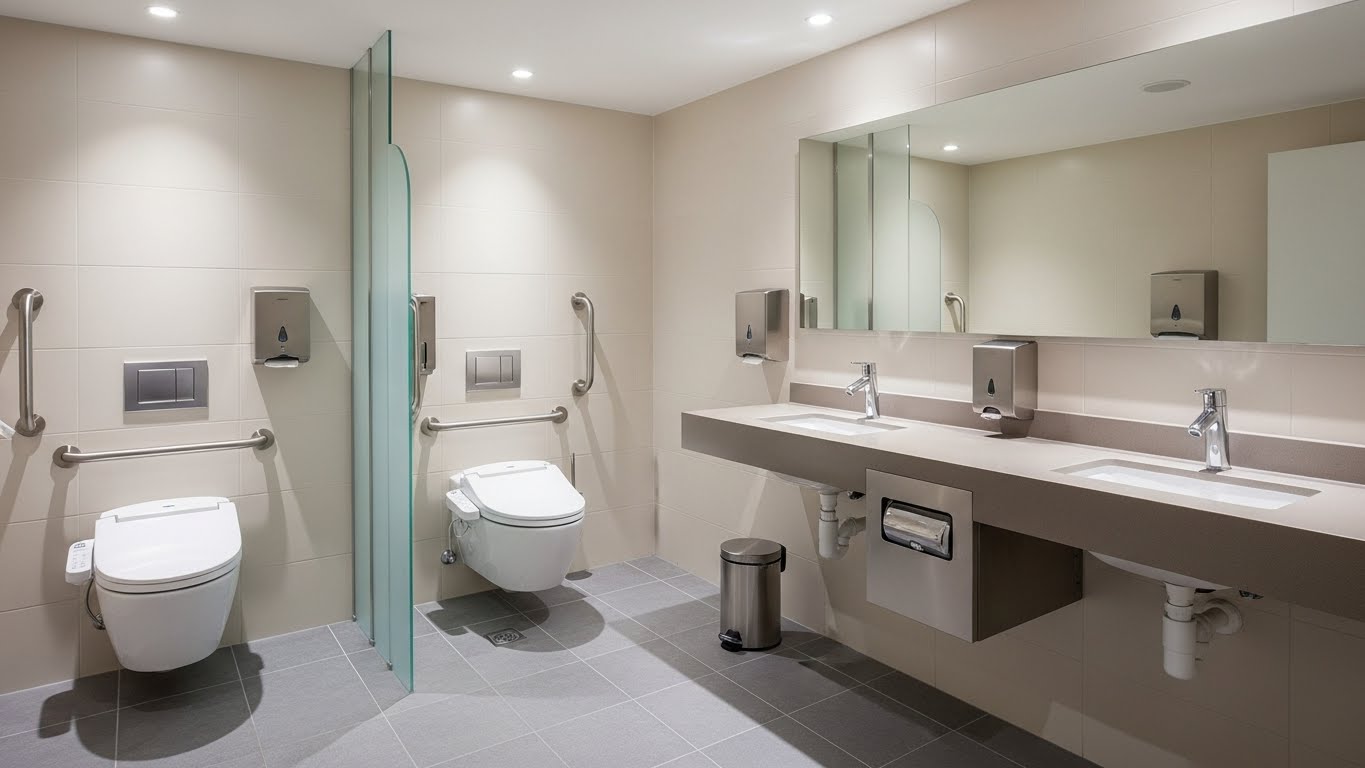
Architects typically need fixture data that supports the required clear floor space, reach ranges, operable parts, and protruding object limits. The pack should reference applicable accessibility standards and clearly state which dimensions are adjustable in the field versus fixed by design.
For US projects, the most common baseline is the 2010 ADA Standards for Accessible Design:
ADA Standards for Accessible Design (2010)
Include in the pack:
Mounting height guidance for dispensers, hand dryers, mirrors, and accessories where relevant
Actuation force and operable parts notes (especially for manual valves and dispensers)
Faucet controls information (lever, sensor, metering) with user interaction description
If the project uses additional criteria beyond ADA (for example, ICC A117.1 via local building code adoption), add a brief “governing accessibility standard” note in the pack to avoid conflicting requirements across sheets.
Water efficiency and sustainability documentation
WaterSense and performance based selection
If water efficiency targets are part of the Owner Project Requirements or sustainability framework, the pack should identify rated flow rates and the certification pathway. For many plumbing products, WaterSense is a common reference point for both efficiency and third party certification context.
WaterSense product specifications overview:
WaterSense product specifications
In the pack, include:
Rated flow rate at a stated pressure (gpm at 60 psi, or other stated condition)
Flow control method (aerator laminar device, pressure compensating)
Notes on sensor cycle behavior, timeout, and metering performance (these can materially change real water use)
Maintenance impact of low flow, such as debris sensitivity and filtration recommendations if provided
CALGreen considerations for California projects
For projects under California’s green building code framework, identify whether the fixture supports mandatory CALGreen provisions or local amendments. CALGreen resource entry point:
CALGreen
Also consider referencing the ICC hosted code text when a project team needs quick navigation of code structure:
California Green Building Standards Code (CAGBC) Preface
In the pack, keep CALGreen references practical:
List the tested flush volumes or flow rates as applicable
Identify whether alternative water sources (reclaimed, graywater) are permitted by the fixture manufacturer and what material compatibility limitations exist
Durability, reliability, and performance standards
Why ASME A112 matters for spec defensibility
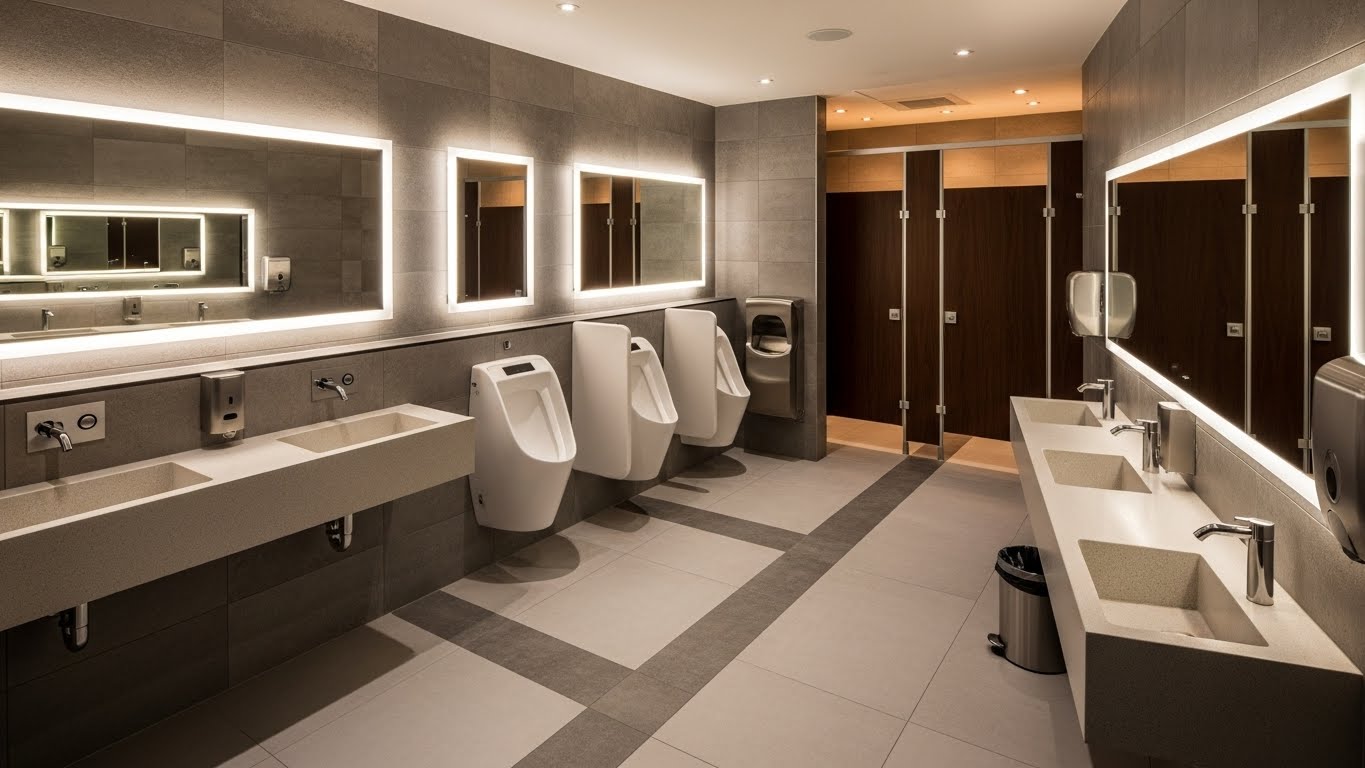
In commercial restrooms, durability is not a preference. It is a risk control measure. Wherever possible, the pack should cite the applicable consensus performance standard for the fixture category. For many plumbing supply fittings, the key reference is ASME A112.18.1 / CSA B125.1.
ASME standard listing (Plumbing Supply Fittings):
Plumbing Supply Fittings (ASME)
For each relevant fixture, capture:
Compliance statement to the applicable ASME or other recognized performance standard
Valve type, cycle life claims (if published), and replacement cartridge model
Inlet filtration requirements and debris tolerance notes
Vandal resistant features (fastener type, concealed mounting, shielding) described in objective terms
When the sheet does not provide cycle testing data, document what is known and leave the rest to submittals. Do not infer durability from finish descriptions alone.
Materials, water quality, and health protection
Commercial projects often require explicit confirmation that wetted materials are compatible with potable water and meet lead content expectations. The pack should identify wetted material types (brass alloy, stainless steel grade, polymers), and provide any third party listing or certification that the design team relies upon.
NSF/ANSI 61 overview:
NSF/ANSI 61: Drinking Water System Components
NSF lead content certification search (NSF/ANSI/CAN 372 category):
NSF Lead Content certification listings
If the project has heightened infection control requirements (healthcare, labs), add surface cleanability notes, chemical compatibility limits, and any replaceable wear components that affect hygiene, such as aerator service intervals or sensor lens cleaning procedures.
System integration and controls coordination
Sensor fixtures and building systems
Touchless fixtures and electronic flush valves add coordination needs across Division 22 and Division 26, and sometimes Division 25. The spec sheet pack should make integration requirements explicit so the design team can avoid late coordination changes.
Include:
Power type (hardwired, battery, hybrid) and power draw where published
Required transformers, junction boxes, and access needs
Fault mode behavior (what happens on power loss)
Optional connectivity or monitoring features and what protocols are supported, if any are offered by the manufacturer
Even if full BMS integration is not planned, documenting power and access requirements in the pack reduces field surprises and helps commissioning teams validate installed configuration.
Submittals, closeout, and lifecycle support
A spec sheet pack should anticipate the full construction cycle. Add a one page “submittal checklist” per fixture type:
Cut sheets and dimensioned drawings matching the selected model
Compliance statements (ADA basis, WaterSense basis, CALGreen basis if applicable, ASME basis where relevant)
Installation instructions and O and M manuals
Spare parts list with part numbers for common wear items (cartridges, solenoids, sensors, batteries)
Warranty terms stated without commentary, plus recommended preventive maintenance intervals if published
For institutional owners, also include:
Recommended stocking levels for critical spares (based on quantity installed)
Compatibility notes for standardized batteries, keys, and service tools across fixture families
Practical takeaway for AEC teams
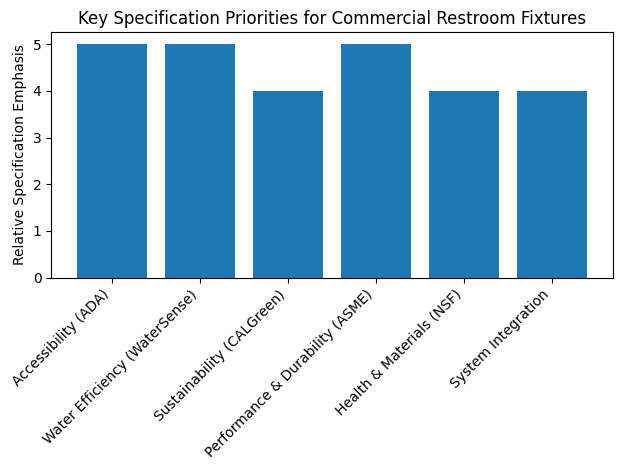
A restroom fixture selection process is strongest when it is documented like a system, not a collection of products. A well built specification sheet pack supports three outcomes: code compliant accessibility, measurable water and energy performance, and maintainable durability under public use. Use the pack to standardize comparisons early, then carry the same data forward into schedules, specs, and submittals so the construction team is installing exactly what was evaluated.
Reference set used in this article
ADA Standards for Accessible Design (2010)
WaterSense product specifications
California Green Building Standards Code (CAGBC) Preface
Plumbing Supply Fittings (ASME)
Reference table
| Section | What to document | Why it matters | Reference |
|---|---|---|---|
| ID and Scope | Model, revision date, application, install type | Prevents wrong substitutions and scope gaps | Cut sheet, submittal |
| Dimensions | Rough in, clearances, access, backing | Avoids clashes, supports serviceability | Dimensioned drawings |
| Accessibility | Heights, reach ranges, operable parts notes | Reduces ADA inspection risk | https://www.ada.gov/law-and-regs/design-standards/2010-stds/ |
| Water Efficiency | Flow rates, test conditions, sensor timing | Impacts compliance and real water use | https://www.epa.gov/watersense/product-specifications |
| CALGreen | Flow or flush values, CA applicability notes | Supports CA and local green code compliance | https://www.dgs.ca.gov/BSC/CALGreen |
| Durability | Performance standard basis, valve type, vandal resistance | Improves lifecycle reliability | https://www.asme.org/codes-standards/find-codes-standards/plumbing-supply-fittings-%28with-10-18-errata%29 |
| Materials and Health | Wetted materials, potable water safety basis | Controls health and compatibility risk | https://www.nsf.org/knowledge-library/nsf-ansi-standard-61-drinking-water-system-components-health-effects |
| Integration | Power type, access, fail behavior, coordination needs | Avoids Div 22 and Div 26 issues | Cut sheet, install guide |
| Submittals and Closeout | O and M, install docs, parts list | Enables turnover and maintenance | Submittal, closeout docs |
Further Reading
External articles referenced for broader context.
No responses yet