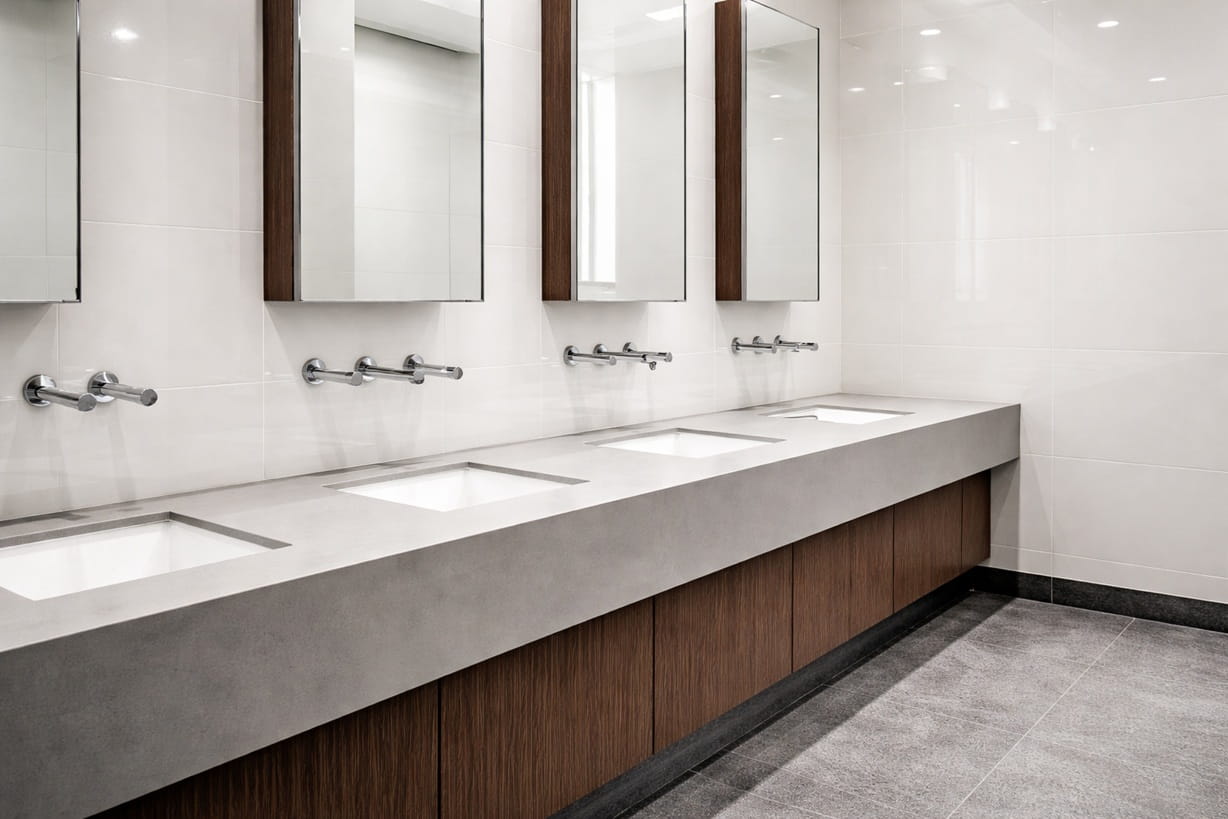
In commercial and institutional work, samples are not decoration. They are evidence tied to durability, accessibility, water efficiency, and long term maintainability.
In commercial and institutional projects, the finish palette is not just visual. It is a performance decision tied to cleanability, chemical resistance, corrosion behavior, accessibility, and long term maintainability. Fixtures add another layer because they combine appearance with mechanical and plumbing requirements, and often include sensors, valves, and electronic power.
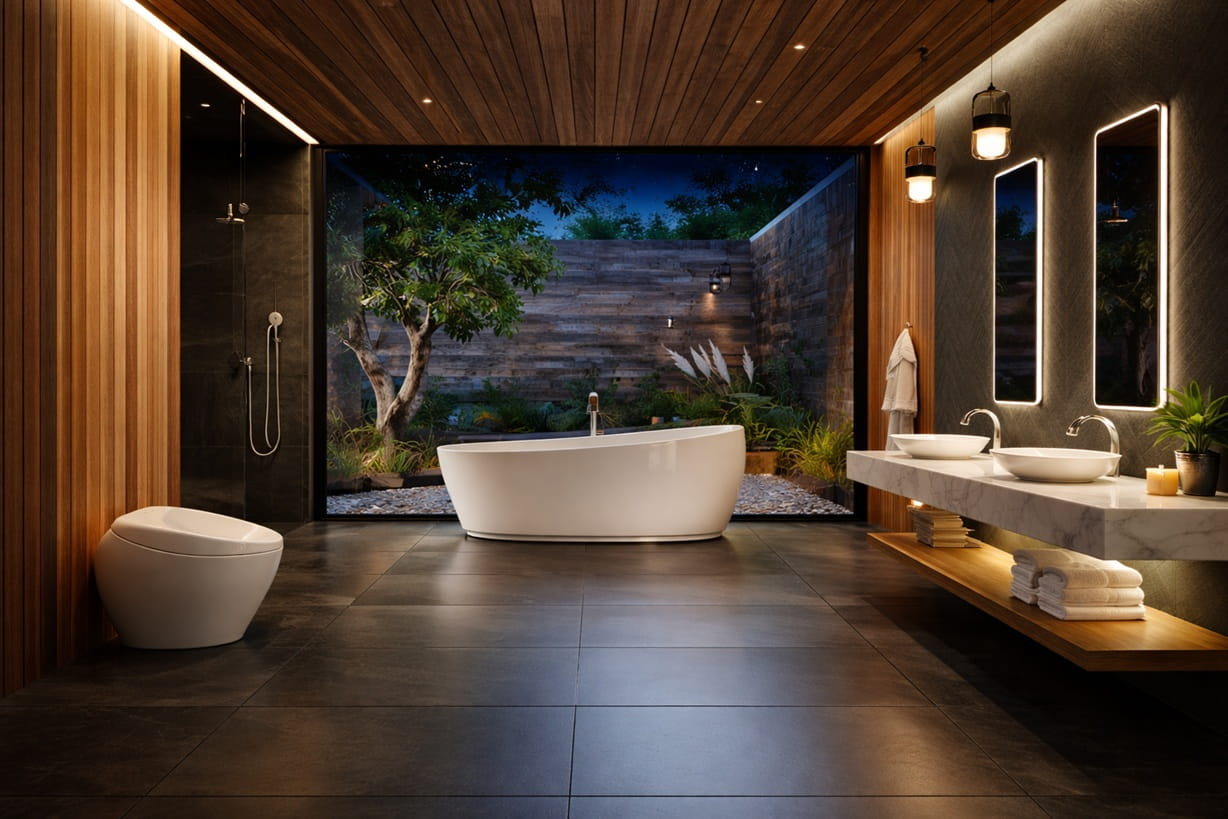
A disciplined finish and fixture sample process helps the design team communicate intent clearly to contractors, fabricators, and facility owners. It also reduces substitution risk and change orders by converting a “look and feel” concept into measurable acceptance criteria.
This guide outlines an AEC grade approach for selecting, documenting, reviewing, and controlling finish and fixture samples in high use restroom and public space environments.
Why samples matter in AEC specifications
Samples are evidence. In a submittal workflow, they create a shared reference point that can be compared against delivered product, installed conditions, and closeout documentation.
Common failure modes on projects often trace back to missing or weak sample controls:
- A finish is approved visually but lacks defined performance expectations, leading to premature wear or corrosion.
- A faucet or accessory is selected for appearance but does not align with accessibility reach ranges, operable force, or clearances.
- Different manufacturers interpret “brushed nickel” or “matte black” differently, causing mismatched assemblies.
- Field touch ups and repairs do not match factory finish, creating visible patchwork and future corrosion points.
A robust sample guide makes the finish intent verifiable, and connects it to durability, compliance, and operations.
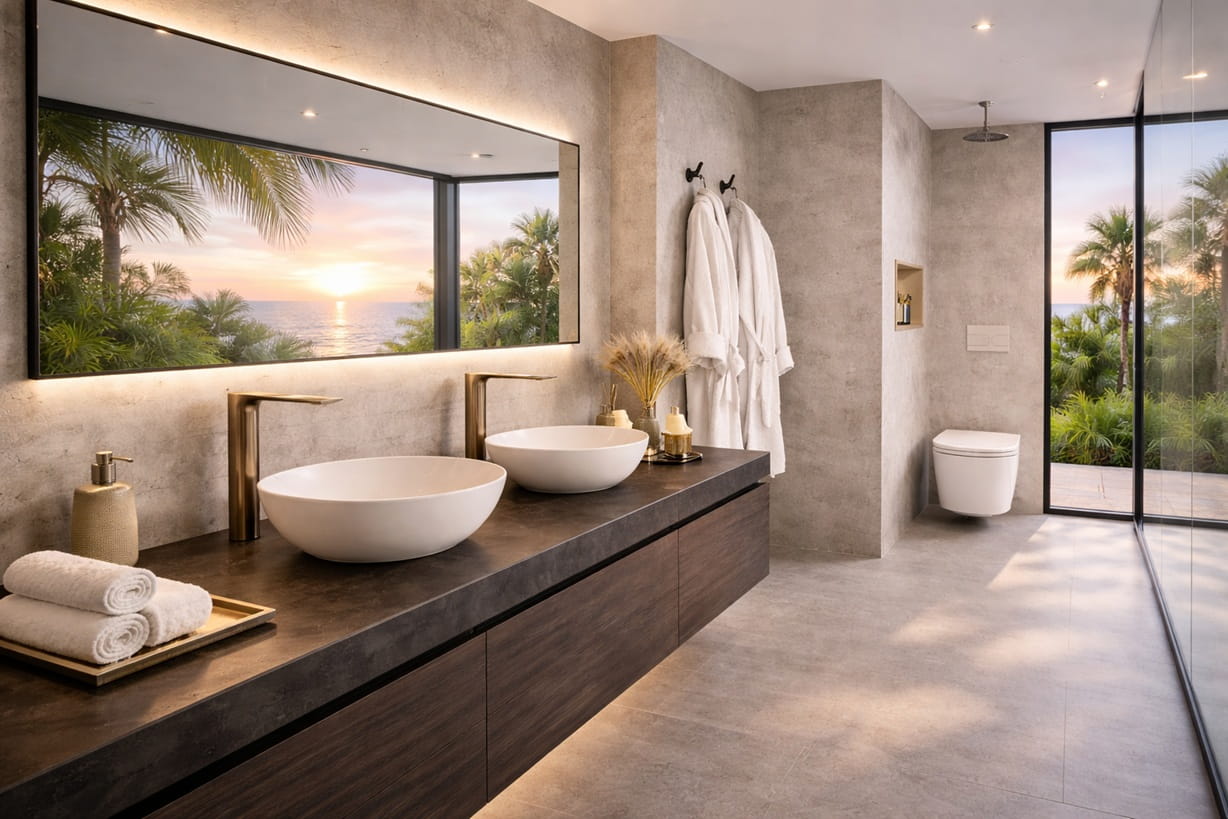
Core sample types and what each should prove
Finish control samples
A finish control sample is the baseline for color, sheen, texture, and reflectance. In public restrooms, it should also represent fingerprint visibility, smudge behavior, and cleaning response. Control samples should be large enough to show directional brushing, edge conditions, and how the finish behaves on radiused surfaces.
For metal finishes, include a statement of finish technology, not just color:
- PVD coating vs powder coat vs electroplating vs anodizing
- Substrate alloy and base preparation
- Topcoat type if applicable
Fixture and accessory samples
Fixture samples should prove both aesthetics and functional interfaces. For plumbing fixtures, include submittal data that documents performance and compliance references such as ASME plumbing supply fittings requirements where applicable. For electronic fixtures, samples should also demonstrate sensor response, power requirements, and service access clearances.
Mockups
Where finishes interact across multiple products, a mockup is often more valuable than isolated chips. A restroom “kit of parts” mockup can validate that faucets, dispensers, grab bars, partitions, mirrors, and hardware read as one coordinated system under project lighting.
Mockups are also the best way to validate maintainability: whether staff can access batteries, valves, filters, or aerators without damaging surfaces.
Documentation that turns a sample into a spec control
A sample without documentation is subjective. To make it enforceable, attach the sample to a structured record.
Finish and fixture schedule fields to include
Add fields beyond the typical “manufacturer and model”:
- Finish code, technology, and sheen target if defined
- Substrate material and grade where relevant
- Cleaning compatibility notes and prohibited chemicals
- Corrosion resistance expectations by environment category (interior dry, interior wet, exterior, coastal)
- Replacement part availability and lead time expectations
- Digital asset identifiers for closeout, such as QR or tag IDs if the owner uses an asset management system
Submittal requirements that reduce ambiguity
Use Division 01 language to define how samples are reviewed and retained:
- Submit two physical samples where feasible: one for approval archive, one for field reference.
- Identify where the “control sample” will be stored on site, and who holds it at turnover.
- Define how substitutions must prove equivalency in both appearance and performance, not just “or equal” language.
Durability and performance criteria for high traffic environments
Commercial and institutional restrooms see repeated impacts, aggressive cleaning, and wet exposure cycles. A finish sample review should be paired with performance expectations.
Corrosion and adhesion references
For metallic components and coated parts, it is common to reference standardized test methods to define minimum performance targets. Two widely cited examples are salt spray and tape adhesion tests.
ASTM B117 overview and purchase page:
ASTM B117 standard listing
ASTM D3359 overview and purchase page:
ASTM D3359 standard listing
Your specification can require the manufacturer to provide test reports or third party certifications aligned with relevant standards for the finish type. The goal is not to over specify a single test, but to require credible evidence that the finish system is appropriate for the exposure class and cleaning regimen.
Cleaning chemistry compatibility
A sample board review should include the facility’s likely disinfectant classes. Quaternary ammonium compounds, peroxide based cleaners, and chlorine based products can affect coatings differently. Include an explicit cleaning and disinfection compatibility statement in the submittal package, and prohibit abrasive pads that alter sheen.
Finish matching and field repair rules
For durable control, define how touch ups are handled:
- Require factory finished components where practical.
- Limit field painting on exposed architectural hardware.
- If field repair is unavoidable, require a documented method and an approved repair kit that matches the control sample under project lighting.
Accessibility and water efficiency implications
Finish and fixture selections often intersect with code and certification requirements. Samples should be reviewed with compliance in mind, not after procurement.
ADA considerations
Fixtures and accessories can fail accessibility requirements due to mounting height, reach range, clear floor space conflicts, or operable part complexity. When reviewing fixture samples, confirm that the product’s controls and installation geometry can meet the project’s accessibility layout.
Primary reference for the 2010 ADA Standards for Accessible Design:
2010 ADA Standards for Accessible Design
WaterSense considerations
If the project has water efficiency goals, confirm that selected faucets, showerheads, urinals, and toilets align with WaterSense labeled products where appropriate, and that flow rates match the design basis.
EPA WaterSense product specifications hub:
EPA WaterSense Product Specifications
EPA WaterSense bathroom faucets overview:
EPA WaterSense Bathroom Faucets
CALGreen considerations
For California projects or owners using CALGreen benchmarks, fixtures and fittings should be checked against the applicable prescriptive or performance based reductions, and documentation should show how the chosen products support the compliance pathway.
CALGreen related code section example:
CALGreen Appendix A5 Section A5.303.2.3.1
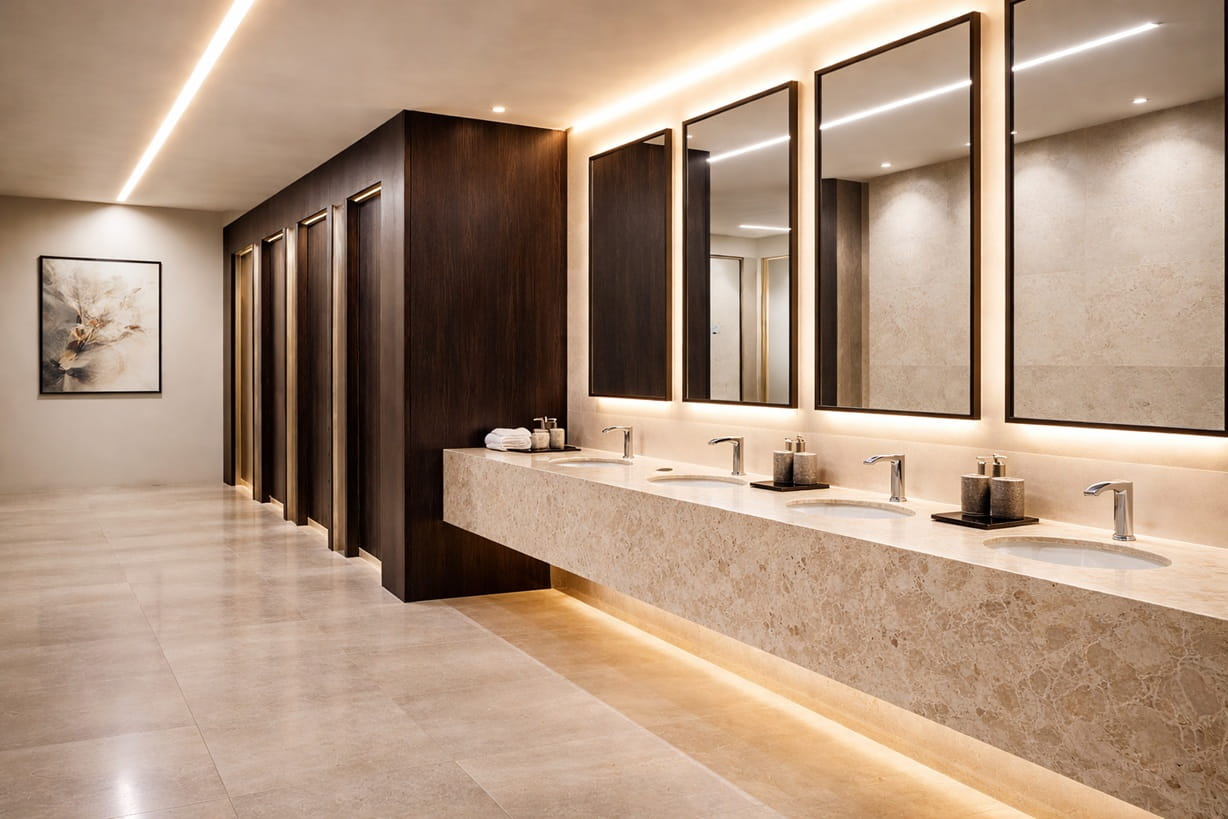
System integration and closeout value
In modern commercial facilities, fixtures can be part of a broader operational system. Touchless faucets, soap dispensers, flush valves, and hand dryers may require coordinated power, access panels, and maintenance protocols.
A sample review process should verify:
- Service access clearance and tool requirements
- Power method, voltage, and battery life expectations
- Commissioning needs if sensor behavior is configurable
- Spare parts strategy for items with known wear components, such as solenoids, aerators, cartridges, or sensors
For plumbing supply fittings, performance and scope references are often tied to harmonized standards such as ASME A112.18.1 and CSA B125.1, which address design, materials, and testing expectations for fittings in the supply chain.
ASME plumbing supply fittings standard listing:
ASME Plumbing Supply Fittings standard listing
Practical workflow for design teams
A repeatable workflow keeps samples from becoming a last minute scramble.
Recommended sequence
- Define performance expectations early: exposure class, cleaning regime, vandal resistance needs, and sustainability targets.
- Build a finish matrix: list each surface and component category with allowable finish technologies and exclusions.
- Require coordinated sample submittals: one package for all restroom metals and fixtures reduces mismatch risk.
- Approve a control set: archive it and reference it in procurement and punch list criteria.
- Validate in a mockup: confirm coordination under actual lighting and with actual substrates.
- Carry controls through closeout: include the approved schedule, cut sheets, maintenance requirements, and spare parts list in O and M manuals.
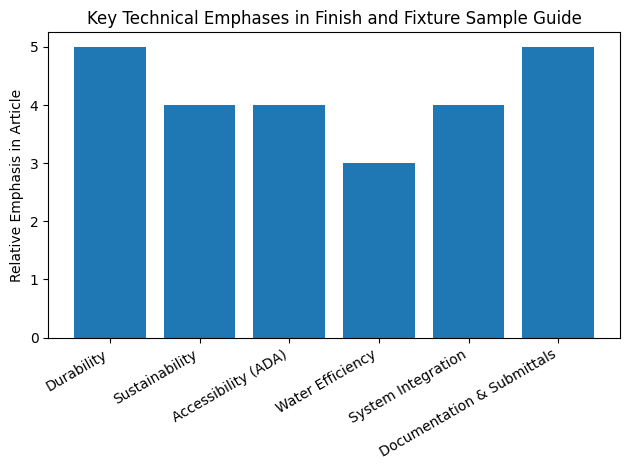
Reference links used in this article
ADA
2010 ADA Standards for Accessible Design
2010 ADA Standards for Accessible Design
WaterSense
EPA WaterSense Product Specifications
EPA WaterSense Product Specifications
EPA WaterSense Bathroom Faucets
EPA WaterSense Bathroom Faucets
CALGreen
CALGreen Appendix A5 Section A5.303.2.3.1
CALGreen Appendix A5 Section A5.303.2.3.1
ASTM
ASTM B117 standard listing
ASTM B117 standard listing
ASTM D3359 standard listing
ASTM D3359 standard listing
ASME
ASME Plumbing Supply Fittings standard listing
ASME Plumbing Supply Fittings standard listing
Summary table
| Topic | What to do | What to verify | Output |
|---|---|---|---|
| Purpose | Treat samples as evidence | Prevent mismatches, substitutions, premature wear | Clear design intent baseline |
| Sample types | Use finish controls, fixture samples, mockups | Appearance plus functional interfaces | Coordinated approval set |
| Finish controls | Approve a true control sample | Finish tech, substrate, sheen, cleanability | Field comparison standard |
| Fixture samples | Review fixtures as systems | Compliance references, service access, power | Submittal ready package |
| Mockups | Validate a full kit of parts | Coordination under project lighting, maintainability | Mockup acceptance criteria |
| Documentation | Make samples enforceable | Schedule fields plus Division 01 rules | Spec control record |
| Durability | Pair visual approval with performance | Corrosion, adhesion, cleaning chemistry limits | Finish performance expectations |
| ADA | Check accessibility during selection | Reach, clearances, operable parts | Fewer late fixes |
| WaterSense | Confirm water efficiency intent | Label status where relevant, flow rates | Water compliance support |
| CALGreen | Align with pathway requirements | Prescriptive or performance alignment | Documentation for compliance |
| Integration | Plan for operations | Access, commissioning needs, spares | Owner ready closeout |
| Workflow | Follow a repeatable sequence | Controls carried to closeout | Reduced risk and change orders |