
Architects and engineers increasingly design automated plumbing systems that treat sensing technology as an integral performance component rather than a peripheral accessory. In high-traffic airports, stadiums, healthcare facilities, and transit hubs, the choice of sensor activation directly impacts hygiene, water efficiency, accessibility, reliability, durability, and building-level integration of digital systems.
The following white paper compares infrared, time-of-flight, and capacitive sensing technologies, referring to ADA, CALGreen, WaterSense, and ASME frameworks that shape specification decisions.
1. Why Sensor Technology Matters in High-Traffic Restrooms
Touchless activation has become the baseline expectation within both public and institutional restrooms. The platform of the sensor selected will influence:
- Hygiene and contamination control
- Water and energy efficiency
- ADA-compliant reach and operability
- Maintenance cycles and service reliability
- Smart-building integration: BMS, analytics, ESG reporting
High-traffic facilities can see millions of operational cycles over a fixture’s life. Under these conditions, sensor precision, false-trigger suppression, sealing integrity, and calibration stability become major determinants of lifecycle performance. A mis-specified sensor technology can lead to nuisance activations, customer complaints, difficult maintenance, and higher total cost of ownership.
Section URL References
Water use and fixture efficiency:
- EPA – WaterSense at Work
Accessibility and reach ranges:
- U.S. Access Board – ADA Chapter 6
2. Infrared Sensors
How IR Works
IR sensors emit near-infrared light and interpret reflected light as the presence of a hand or object in range. Performance depends heavily upon surface reflectivity, lighting conditions, and line-of-sight between the emitter, the target, and the receiver.
Strengths
- Low cost
- Quick response time
- Widely compatible with existing fixtures and retrofit kits
Limitations
- Susceptible to glare or direct sunlight
- Reflective surfaces can cause false triggers
- Line-of-sight interruptions reduce reliability
- Sensitivity to basin geometry; performance can vary widely from model to model
Top Uses
- Cost-constrained retrofit projects
- Equally lit rooms with limited direct sunlight
- Standard public wash basins with predictable geometry
Design & Specification Notes
- Avoid mirror-polished finishes directly facing the sensor.
- Request modules with auto-calibration and ambient-light compensation.
- Provide fixture spacing to reduce IR “spillover” between adjacent stations.
Section URL References
Infrared and optical sensing basics:
- NASA – Infrared Sensors Overview
- SPIE – Optical Sensor Basics Resource
3. Time-of-Flight (ToF) Sensors
How ToF Works
The time-of-flight sensor projects pulsed light and measures the time of flight for the light that travels to and from nearby surfaces. Using this information, the sensor constructs an accurate distance profile to greatly reduce false activations in reflective, complex, or changing-light conditions.
Strengths
- Excellent distance and presence precision
- Stable performance under reflective finishes and complex lighting
- Narrow, well-defined activation zone
- Well-suited for telemetry, diagnostics, and digital facility integration
Limitations
- Higher unit cost compared to basic IR
- Generally higher power consumption
- Installation demands careful alignment and commissioning
Best Applications
- Airports, transit hubs and stadiums with very high throughput
- Healthcare facilities requiring repeatable, highly reliable detection
- Flush valves where “walk-by” suppression is critical to avoid false flushes
Design & Specification Notes
- Define explicit detection range, for instance, 120–150 mm from the outlet.
- Specify enclosures with IP ratings (IP54–IP65), depending on cleaning intensity and washdown practices.
- The commissioning package must require steps for calibration and verification.
Section URL References
Time-of-flight and depth sensing:
- Analog Devices – Time-of-Flight Sensing Overview
- Texas Instruments – Time-of-Flight Sensors Overview
4. Capacitive Sensors
How Capacitive Works
Capacitive sensors work by detecting changes in an electric field caused by the proximity of a conductive mass such as a human hand. The sensors can be mounted behind metal, glass, or solid-surface panels with no visible sensor window; thereby, fully concealing the installation.
Strengths
- Allows for a fully-concealed “behind-the-panel” installation
- High vandal resistance with no exposed lens or opening
- Immune to reflections and ambient light conditions
- Lower debris accumulation compared to exposed sensor windows
Limitations
- Sensitive to material thickness, permittivity, and moisture drift
- Less sharply defined activation boundary than in ToF
- Requires early design coordination with panel materials and construction
Top Applications
- Transit systems, schools, and correctional facilities where vandal resistance is paramount
- Solid-surface or stainless-steel recessed soap dispensers and controls
- Architecturally minimalist bathrooms where visible sensors are undesirable
Design & Specification Notes
- Check the manufacturer recommendations on permissible substrate thickness and materials compatibility.
- Require drift-compensation firmware to deal with changes in humidity and temperature.
- Specify LED or service indicators to help facilities management and custodial personnel.
Section URL References
Capacitive and field-effect sensing:
- Microchip – Capacitive Touch Fundamentals
- Infineon – Capacitive Sensor Overview
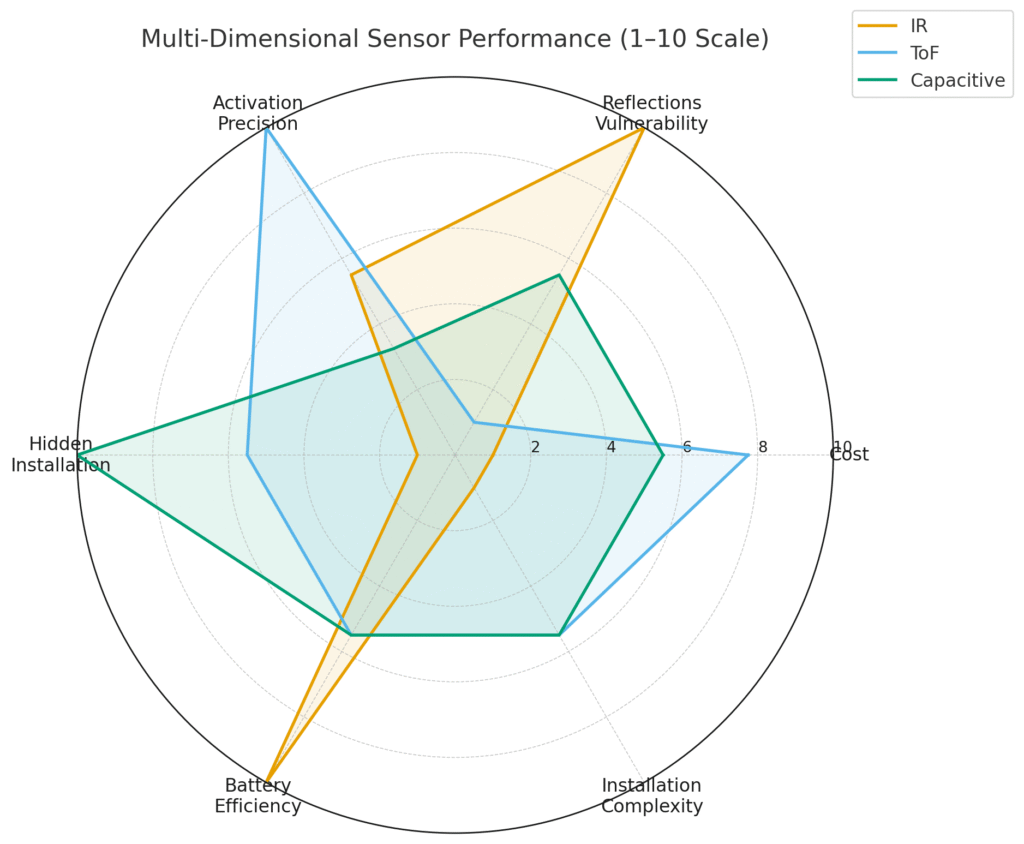
5. Technical Comparison
The following table highlights some key criteria for IR, ToF, and capacitive sensing.
| Criterion | IR | ToF | Capacitive |
|---|---|---|---|
| Cost | Low | Medium–High | Medium |
| Vulnerability to reflections | High | Very Low | Low |
| Activation precision | Good | Excellent | Moderate |
| Potential for hidden installation | Poor | Good | Excellent |
| Battery efficiency | Excellent | Good | Good |
| Installation Complexity | Low | Moderate | Moderate |
Section URL References
Technology Comparison – Optical Sensing Context
- Hamamatsu Photonics – Sensor Product Page
6. Application by Building Type
Different building types place different stresses on sensor technologies.
Airports / Transit Hubs
- Use ToF for faucets and flush valves when precision zones and walk-by suppression are needed.
- Capacitive sensors for hidden and vandal-resistant dispensers and controls.
- Use IR for predictable, well-lit basins in standard public areas.
Stadiums & Arenas
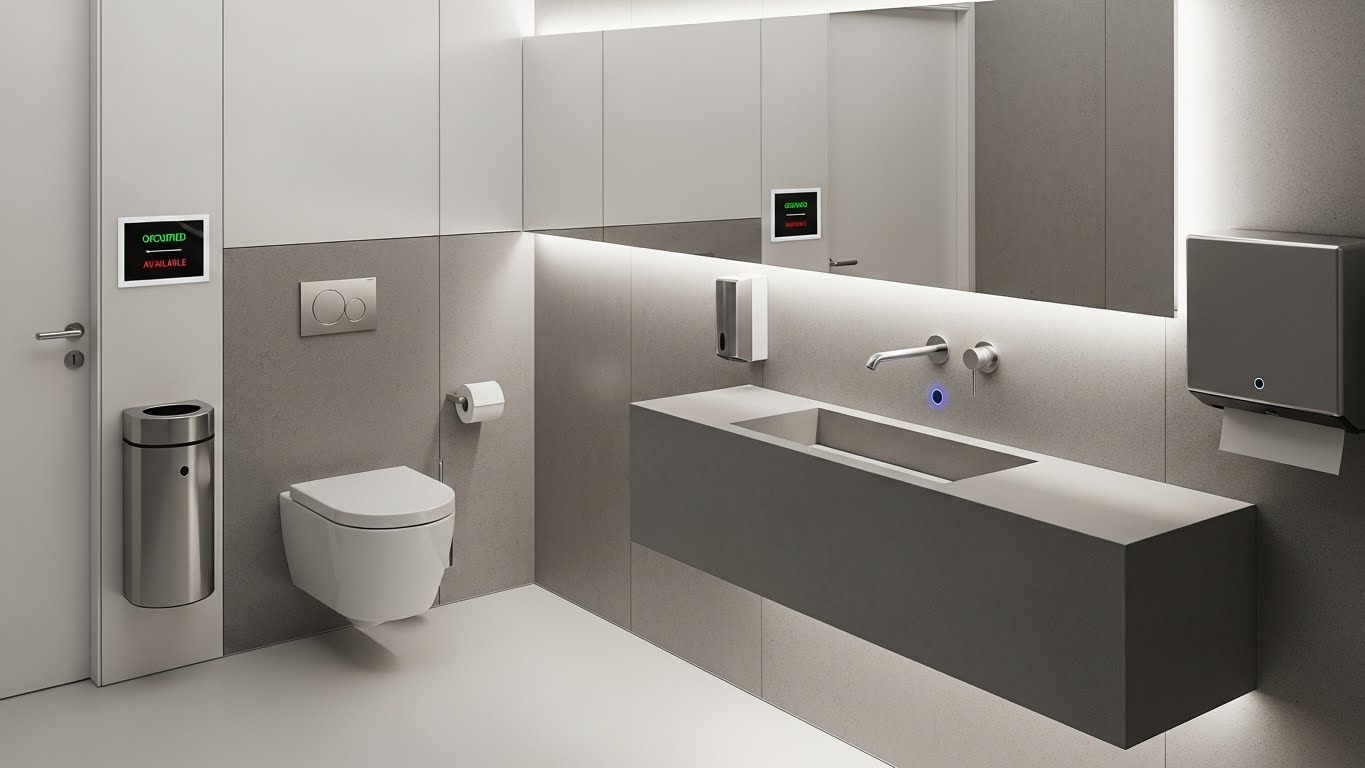
- Favor capacitive sensors mounted behind heavy-duty metal or solid surface panels.
- Deploy ToF for high-throughput fixtures where both accuracy and throughput are important.
- Reserve IR for non-critical, lower-traffic zones or cost-sensitive areas.
Healthcare Facilities
- Choose ToF for high repeatability, low false triggering, and stable performance under aggressive cleaning methods.
- Pair ToF-based fixtures with telemetry for infection-control data, usage analytics, and compliance reporting.
Schools & Campuses
- Tamper-resistant installations in unsupervised high-risk areas should make use of capacitive sensors.
- IR should be used for general lavatories where cost and simplicity remain important drivers.
Section URL References
Public and transit facility guidance:
- WHO – WASH Facilities Public Restroom Design Guidance
- FTA – Transit Facility Engineering Guide
7. Specification Guidelines for AEC Professionals
Detection & Timing Parameters
Document at least:
- Detection windows — range and field of view
- Delay-off times
- Maximum run-time limits
- Lock-out settings to avoid continuous flow or repeated triggering
Lighting & Finish Coordination
- IR: Avoid direct sunlight, glare and mirror-like finishes facing the sensor by coordinating early.
- ToF: Provide alignment and mounting points that respect sensor field of view.
- Capacitive: Verify substrate thickness, material, and mounting details early in design.
Power Strategy
- Hard-wire high-use fixtures — e.g., main concourses, food courts, gate areas.
- Employ lithium batteries or hybrid power where wiring is impracticable or access is limited.
Durability & Environmental Protection
- Specify suitable IP ratings, such as IP54–IP65, based on cleaning methods, washdown frequency, and chemical exposure.
- Confirm sealing strategies against moisture, chemicals and humidity.
- Require cycle-life test data consistent with expected traffic.
Applicable Standards
- ASME A112.18.1 / CSA B125.1 — Plumbing Supply Fittings
- CALGreen (state-level green building requirements)
- WaterSense at Work (EPA)
- ADA Chapter 6 — Plumbing Elements & Facilities
Commissioning
- On-site detection distances and activation zones shall be checked.
- Perform light-interference and reflection testing where either IR or ToF are used.
- Perform drift-compensation checks on capacitive sensors under realistic humidity/temperature conditions.
- Verify BMS integration: BACnet, Modbus, or API for devices with telemetry capability.
Section URL References
- EPA – WaterSense at Work
- U.S. Access Board – ADA Chapter 6
- IEC – IP Ratings Reference
8. Integration with Smart Facility Platforms
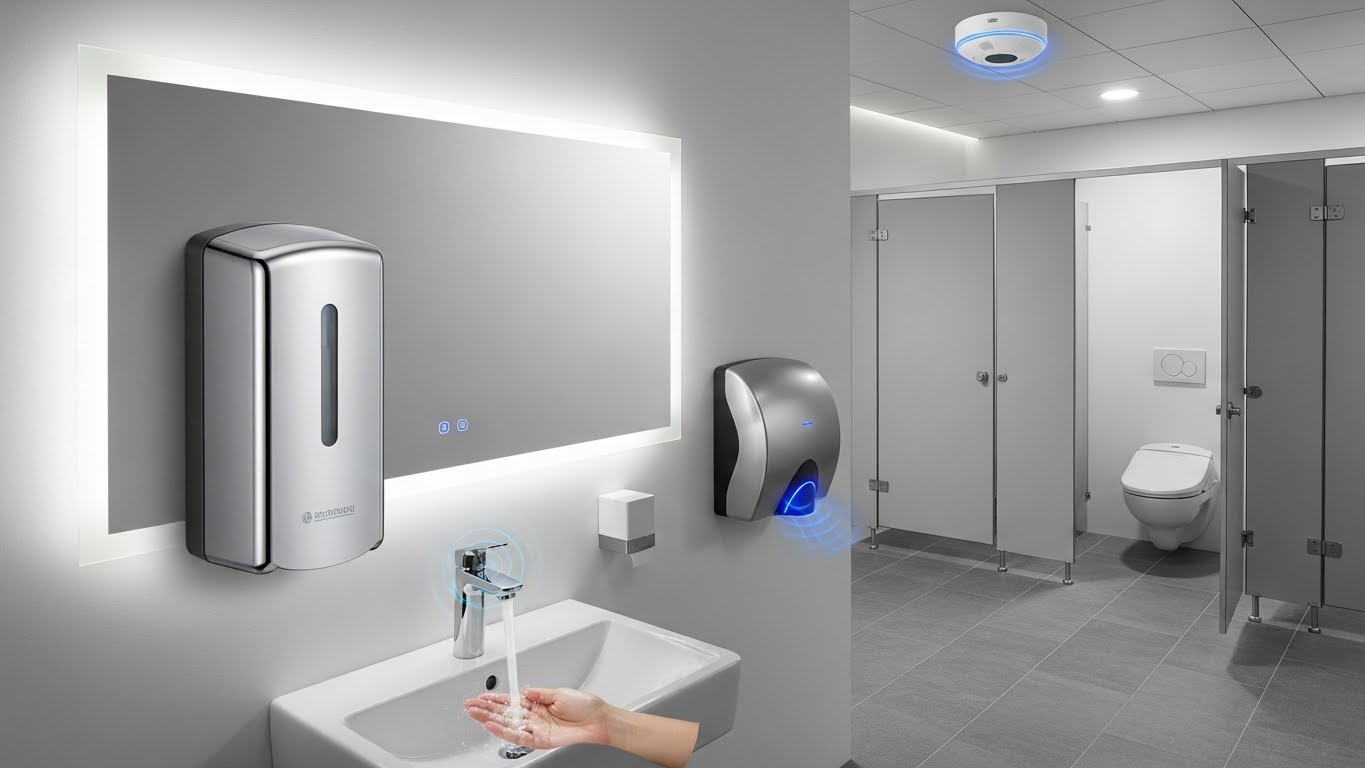
Modern sensing technologies — especially ToF and capacitive implementations — today support:
- Activation counts (usage analytics)
- Battery diagnostics and predictive replacement
- Fault detection: stuck valves, low flow, sensor faults
- Cleaning-cycle analytics and custodial scheduling
- Water-use data for ESG, LEED, and other sustainability reporting
Integration pathways could be BACnet/IP, Modbus TCP, or manufacturer-specific APIs. When specifying, the protocols supported, data points, and cybersecurity practices should be spelled out.
Section URL References
- BACnet – Official Standard Site
- Modbus – Protocol Specifications
9. Retrofit vs. New-Build Strategies
Retrofits
IR is often the most practical solution because it accommodates existing faucet and basin geometries.
Prefer IR modules that have robust ambient-light filtering and auto-calibration.
Where telemetry is needed, consider hybrid IR/ToF options that fit current cutouts.
New Construction
Use ToF where precision, analytics, and integration are key design drivers.
Use capacitive for hidden dispensers and vandal-resistant controls in high-risk zones.
Standardize sensor platforms, modules, and service kits across facility types to simplify maintenance.
Mixed Environments
Use ToF for water delivery fixtures that require precise zones and walk-by suppression.
Employ capacitive for soap dispensers and ancillary controls where concealed design might be preferred or required.
Consolidate service kits and training around a limited set of sensor platforms.
Section URL References
- EPA – Retrofit Plumbing Guidelines (WaterSense)
- GSA – Facility Water Management
10. Quick Selection Guide
Rules of thumb that may help in making quick decisions:
- Need hidden or vandal-resistant actuation → Capacitive
- Require accurate activation depending on reflective or variable lighting conditions → ToF
- Lowest-cost upgrade or retrofit → IR
- Strict, well-defined activation zone required → ToF
- Facility needs analytics and telemetry → ToF or Capacitive
Section URL References
- WBDG – Architectural Plumbing Design Resource
- CDC – Public Restroom Performance Standards
Conclusion
Sensor technologies must be selected deliberately with a view to performance expectations, durability requirements, accessibility mandates, and sustainability frameworks in high-traffic restrooms. A clear pattern emerges:
- ToF → Precision, reliability, and smart-facility integration
- Capacitive → Hidden installations, vandal-resistant, material-agnostic
- IR → Budget-optimized, predictable retrofit environments
Harmonized with ADA, WaterSense, CALGreen, and ASME A112.18.1, the technologies support durable, efficient, and resource-conscious plumbing systems serving modern commercial and institutional buildings over long service lives.
Verified links & reference sources
Water Efficiency Management Guide Bathroom Suite
EPA WaterSense resource guide for bathroom fixture efficiency and water management.
Capacitive Sensor Layout Recommendation Manual (Lumissil)
Layout, shielding, and moisture tolerance patterns for capacitive sensing design.
IS31SE5118A — 8-CH Programmable Capacitive Touch Sensor
Datasheet reference for multi-channel capacitive touch sensor architecture and features.
Common Inductive and Capacitive Sensing Applications (TI)
Application guide covering capacitive sensing use cases, drift behavior, and design tradeoffs.
Key Facts and Figures — World Health Organization (WHO)
Hand hygiene context and global infection control performance insights.