Check the spec sheet for alloy designation and weight before you check the finish. A solid brass body (UNS C36000 or similar) typically runs 30 to 40 percent heavier than a zinc body (Zamak 3) of the same dimensions, and the spec sheet should state the alloy outright. If it just says “brass finish” or “brass look,” you’re looking at zinc or a composite body with a brass-toned plating, not a brass casting.
The Concept: Exposed Industrial Bridge Faucet
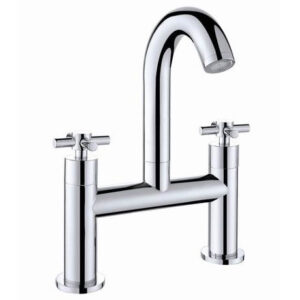
The bridge faucet is the fixture that makes this decision visible. Two exposed legs, exposed cross handles, a visible spout arm, nothing hidden behind an escutcheon. On a standard single-hole faucet, body material is almost a non-issue because you never see or touch the casting directly. On a bridge faucet, you grip the body every time you turn the water on. The legs take lateral stress when someone leans on the faucet to wipe the counter. The joints are visible, so plating quality and seam work show. This is a design where the material spec is not a background decision. It is load-bearing and it is on display.
Why Body Material Changes the Spec
For a wall-mount or deck-mount bridge faucet, material choice touches four things on the spec sheet: weight tolerance for the mounting hardware, thread engagement at the supply connections, plating thickness over the substrate, and NSF/ANSI 61 compliance for wetted components. Zinc and brass are both viable, but they are not interchangeable once you write the spec, because the mounting brackets, the valve cartridge seating, and the expected service life all shift depending on which one you pick.
Reading Spec Sheets: Brass vs Zinc Clues
Most manufacturers do not volunteer the alloy. You have to ask the right question or read between the lines. UNS C36000, sometimes called free-cutting brass, is a copper-zinc alloy (roughly 60 percent copper, 35 percent zinc, 3 percent lead) that machines cleanly and threads reliably. Zamak 3, the most common die-cast zinc alloy in fixture bodies, is primarily zinc with small amounts of aluminum, magnesium, and copper. It casts into complex shapes cheaply and takes plating well, but it is softer and more brittle under stress than brass.
Here is what to look for on a spec sheet or product page:
- Alloy callout: “Solid brass body” with a UNS number or “C3” designation is brass. “Brass finish,” “brass look,” or no alloy mentioned at all is almost always zinc or a mixed-metal assembly.
- Weight listed in spec: A bridge faucet body in solid brass commonly lands in the 4 to 7 lb range depending on spout length and leg height. A comparable zinc-body unit often comes in noticeably lighter. If weight isn’t published, ask for it, or weigh the floor sample.
- NSF/ANSI 61 certification: This standard governs leaching from wetted components into potable water. Reputable brass and properly formulated zinc fixtures can both certify, but low-cost zinc castings sometimes skip third-party testing. Ask for the certificate, not just the claim.
- Thread specification: Supply connections are standard 1/2 inch NPT or compression fittings regardless of body material, but the thread engagement depth and the number of full thread turns before hand-tight resistance will differ. Brass holds threads through more remake cycles; zinc threads can gall or strip if a cartridge is removed and reseated repeatedly.
Weight, Threads, and Finish Durability Tests
If you can get a sample in hand, three checks tell you more than any data sheet. First, weight: pick it up. Brass feels dense in a way that is hard to fake. Second, thread engagement: thread a supply nut on by hand and count turns to resistance. Brass fittings typically engage more smoothly and take more remake cycles without wear. Zinc threads, especially on lower-cost castings, can feel slightly gritty or inconsistent because the alloy is softer and more prone to burring during manufacture. Third, finish: ask for plating thickness in microns. Chrome plating over brass commonly runs in the 0.3 to 0.5 micron range for the chrome layer itself, sitting over a nickel underlayer of roughly 8 to 12 microns, which is what actually provides corrosion resistance and fills minor casting imperfections. Over zinc, platers typically need a heavier nickel underlayer, often in the 10 to 15 micron range, because zinc castings have more surface porosity and the nickel has to do more work to create a smooth base for the final chrome or PVD layer. Thinner plating over zinc wears through faster at contact points like handle grips and lever pivots, which on a bridge faucet is exactly where your hand lands every day.
PVD finishes change this math. PVD coatings bond at the molecular level and can be applied effectively to either substrate, but the published longevity claims for PVD almost always assume a brass or stainless substrate underneath. Ask the supplier directly whether PVD warranty coverage changes based on body material. Some manufacturers quietly exclude zinc-body fixtures from their longer PVD warranties, and that exclusion is often buried in the fine print, not the headline spec.
| Attribute | Solid Brass (C36000) | Zinc Alloy (Zamak 3) |
|---|---|---|
| Typical body weight | Noticeably heavier, dense feel | Lighter, can feel hollow |
| Thread durability | Holds up over repeated cartridge service | Prone to galling after multiple remakes |
| Plating base | Smoother casting, thinner nickel underlayer needed | More porous, needs heavier nickel underlayer |
| Casting detail | Good, but costlier tooling for fine detail | Excellent for intricate ornamental shapes |
| Typical cost position | Higher material and machining cost | Lower material cost, faster casting cycle |
Matching Material to the Design Intent
An exposed industrial bridge faucet is meant to read as mechanical and substantial. The whole design language depends on the legs, handles, and spout arm feeling like they were machined, not molded. That intent points toward solid brass. The weight in hand reinforces the industrial read every time someone uses the faucet, and the thread durability matters more here than on a concealed single-hole faucet because bridge faucet cartridges tend to get serviced more often due to the exposed, higher-torque handle design.
Zinc isn’t the wrong answer everywhere. If the design intent leans toward ornamental detail, scrollwork, cast rosettes, period-accurate florets, zinc’s casting flexibility is a genuine advantage, because it captures fine detail that brass tooling makes expensive to replicate. That’s a common path for traditional and antique-style work. If you’re specifying traditional bathroom faucets in an aged or living brass finish for a period bathroom, the ornamental casting quality and the patina behavior of the finish often matter more to the final look than body material alone, and zinc bodies with well-executed plating can hold their own in that context.
Final Fixture Pick and Sourcing Notes
For the industrial bridge faucet concept, specify solid brass, UNS C36000 or equivalent, with documented NSF/ANSI 61 certification for all wetted components. Request the nickel underlayer thickness in microns before you request the chrome or PVD topcoat thickness, since the underlayer is what actually protects against pinhole corrosion over time. Confirm 1/2 inch NPT supply connections and ask the supplier directly how many cartridge service cycles the threads are rated for, since this is rarely printed but suppliers who work with brass regularly will have an answer.
Before you place the order, get the alloy designation and the NSF certificate in writing, not just a verbal confirmation from a sales rep. If a supplier can’t produce either document on request, treat that as a sourcing red flag regardless of how the fixture photographs. For a visible, touch-heavy fixture like a bridge faucet, the spec sheet is doing real work, and it’s worth the extra round of questions before the PO goes out.